
CAFC Forced to Disturb Earlier Ruling Based on More Liberal Patent Reexamination Standards


Patent reexamination is often initiated in parallel with an ongoing infringement litigation. In some cases, an infringer that fails to prove invalidity in the courts can effectively “undo” the effect of the earlier court judgement via an ex parte patent reexamination (EXP) filing.


Back in December, the CAFC considered this “do over” tactic in the case of In re Construction Equipment. Last week, the very same procedural fact pattern presented itself to the CAFC. Once again, Judge Newman decried the potential undermining of previously settled court rulings via ex parte patent reexamination.


As a reminder, when initiating a parallel inter partes proceeding (IPX) parallel to a district court litigation, the first of the proceedings to conclude (litigation or IPX) controls the outcome of the other by operation of statutory estoppel. As such, a final holding in the parallel court proceeding will end an ongoing IPX. Moreover, the losing party would be precluded from seeking IPX at a later date. As such, an infringer that fails to prove invalidity in the district court cannot hope to be saved by a parallel IPX; not so with EXP.


EXP has no such statutory “shut off valve.” Thus, even a party that was bound by IPX estoppel could file a request for EXP in an attempt to “undo” the effect of an the earlier court judgement, as was the case a few months back in the case of In re Construction Equipment, and again last week in the case of In re Baxter International Inc. (here)


In Baxter, the CAFC considered an appeal from the Board of Patent Appeals & Interferences (BPAI) that found certain claims of U.S. Patent 5,247,434 unpatentable as a result of EXP. The Court affirmed the BPAI despite the fact that in 2009, the CAFC affirmed a district court ruling finding the very same claims not invalid. The majority (Lourie, Moore) explained:


Lest it be feared that we are erroneously elevating a decision by the PTO over a decision by a federal district court, which decision has been affirmed by this court, the following additional comments must be made. When a party who has lost in a court proceeding challenging a patent, from which no additional appeal is possible, provokes a reexamination in the PTO, using the same presentations and arguments, even with a more lenient standard of proof, the PTO ideally should not arrive at a different conclusion.

However, the fact is that Congress has provided for a reexamination system that permits challenges to patents by third parties, even those who have lost in prior judicial proceedings. Usually one would expect that any such reexamination, such as the one before us, would raise new issues. In this case, the patent examiner relied on new prior art that had not been raised in the prior district court proceeding. Why Fresenius did not present that prior art before the district court we do not know. But the Director apparently found that a substantial new question of patentability had been raised and the examiner was then entitled to conduct a reexamination on the basis of the new art presented and her search of the prior art. Thus, this case is not about the relative primacy of the courts and the PTO, about which there can be no dispute. Finally, we could not conclude that the PTO was barred from conducting the reexamination of the ’434 patent because of the final judgment in Fresenius without over-ruling Ethicon and Swanson, which we cannot do.

Consistent with her earlier dissent in In re Construction Equipment, Judge Newman argued:

Administrative agency override of judicial final decisions has no counterpart in any other field of subject matter. From the inception of judicial process in the nation, it was established that decisions of Article III courts are not subject to negation by proceedings in the other branches. The validity of the Baxter patent was resolved upon litigation in the district court and on appeal to the Federal Circuit. This judgment cannot be “revised, overturned or refused full faith and credit by another Department of Government.” Chi. & S. Airlines, 333 U.S. at 114. Nonetheless, the court again departs from this principle, trivializes our prior final judgment, and simply defers to the conflicting agency ruling. This is improper.

I support the concept of reexamination as an efficient and economical alternative to litigation in appropriate cases. My concern is with the distortion of this purpose, which was designed to provide a path to relief not available through the existing examination process. It was not intended to undermine the finality of judicial process; it was not intended to negate the repose provided by adjudication.

The only patents that are reexamined, like the only patents that are litigated, are patents on inventions that are of value. Most reexamination requests are granted by the PTO. Reexamination of the Baxter patent was requested by Fresenius in 2005, two years into the litigation of Fresenius’ declaratory judgment action against Baxter. The reexamination request presented to the PTO the same references that Fresenius had presented in the litigation. Judgment in the district court was adverse to Fresenius, and the Federal Circuit’s final judgment was issued in 2009, a year before the reexamination decision of the PTO Board. The Board stated that “the agency is not bound by the court’s determination.” BPAI Op. at 26. However, when there has been full litigation and final adjudication under Article III, the judicial resolution controls. Instead, my colleagues ignore this court’s prior decision, which is the law of this case, and simply defers to the PTO, stating that its reexamination ruling is “supported by substantial evidence.” Op. at 11–13 & 16. The nature of the burden of proof does not overcome the strictures of judicial finality.


The ability to file an ex parte patent reexamination as a “do over” relative to an adverse ruling of the courts remains a viable option even after the America Invents Act (save for those filers subject to the estoppel effect of Inter Partes Review or Post Grant Review).

Improvements Speed Patent Reexamination Process

At last week’s AIPLA Spring Meeting, the Director of the Central Reexamination Unit (CRU), Ms. Remy Yucel provided an update on the continued efforts of the USPTO to refine the patent reexamination process. The Director reported that the time to printing of  a reexamination certificate has improved, and that the Office is continuing to consider the stream line proposals published in the Spring of 2011 (at least as they relate to ex parte patent reexaminations). (presentation here)

Pursuant to the America Invents Act, all contested proceedings will now be the sole jurisdiction of the new Patent Trial & Appeal Board (PTAB). Thus, the CRU, will finish up its work on legacy inter partes reexaminations going forward, but will see no new requests for such after September 14th. After September 16th, the CRU will process requests for Supplemental Examination (SE). However, it remains to be seen whether or not SE will be embraced by stakeholders

House Hearing Wednesday May 16th

Tomorrow, the House Judiciary Committee will hold a hearing on the Implementation of the America Invents Act at 10AM. The hearing will be webcast, information is found (here).

The agenda provides a list of speakers, some of which will discuss the implementation of the new post grant proceedings. It is also likely that the Director of the USPTO will report on the results of the Study on Genetic Testing (AIA, Sec. 27) and perhaps other studies commisioned by the Act. (e.g., Patent Litigation, AIA Sec. 34).

Reach of Estoppel More of a Concern After AIA

The application of statutory estoppel to patent challengers was a concept first introduced in 1999 with the advent of inter partes patent reexamination (IPX). Initially, many sensationalized the estoppel effect of IPX together with the unpredictability of the reexamination process as justification to avoid use of the new proceeding. Over the years, due to the consistent performance of the USPTO’s Central Reexamination Unit (CRU), and perhaps to a greater extent, the 5-7 year duration of a fully contested IPX, patent challengers realized the estoppel risk to be an insignificant factor for most patent disputes (since most conclude before estoppel can attach). For this reason, the estoppel mechanics as to real-parties-in-interest and privies were infrequently considered by the courts, or USPTO.

Going forward, estoppel may once again become a concern for patent challengers under the new proceedings of the America Invents Act (AIA).

Inter Partes Review (IPR), Post Grant Review (PGR), and the Transitional Program for Covered Business Method Patents (TPCBMP), all have their own estoppel provisions. In view of the fact that all of these proceedings are designed to end within 12 months, estoppel is now a more clear and present danger. As such, it is now more important than ever for patent challengers to understand the meaning of “real party-in-interest” and “privies.”

In addition to the proposed rules for implementing these proceedings, the USPTO has provided the following explanation of real-party-in-interests and privy:

The Office proposed that the petitioner in one of the new administrative trial proceedings of inter partes review, post grant review, and covered business method review must identify the real party in interest. . . .

[I]dentification of the real party in interest alerts the Board of potential statutory bars to the proceeding.  For inter partes review (IPR) and post-grant review (PGR) proceedings, the petitioner (including any real party in interest or privy of the petitioner) is estopped by statute from re-litigating any ground that was raised or reasonably could have been raised in an earlier proceeding.  See 35 U.S.C. 315(e)(1) and 325(e)(1).  Thus, the petitioner must establish that he/she or its privy has not previously raised or had the opportunity to raise the ground in dispute in a previous IPR or PGR proceeding.

To that end, the Office proposes that the petitioner must certify at the time of filing a petition that he/she is not estopped from requesting an IPR or PGR of the patent.  . . .

Who constitutes a real party in interest or privy is a highly fact-dependent question, especially on the issue of whether a party who is not a named participant in a given proceeding nonetheless constitutes a “real party in interest” or “privy” to that proceeding.  Courts and commentators agree that there is no “bright-line test” for determining the necessary quantity or degree of participation to qualify as a “real party in interest” or “privy” based on the control concept.  See Gonzalez v. Banco Cent. Corp., 27 F.3d 751, 759 (1st Cir. 1994); see alsoWright & Miller § 44512 (“The measure of control by a nonparty that justifies preclusion cannot be defined rigidly.”).  Accordingly, the Office has not enumerated particular factors regarding a “control” theory of “real party in interest” or “privy” in the proposed rules.  Instead, to resolve a real party in interest or privy dispute that may arise during a proceeding, the Board plans to consider each case on its specific facts.

In sum, the USPTO believes the proposed rules provide (i) petitioners the ability to establish standing; (ii) patent owners the opportunity to challenge the petitioner’s standing in appropriate situations; and (iii) the Board the flexibility to consider the specific facts and relevant case law in resolving a standing dispute.

Once an IPR, PGR, or TPCBMP fails to render an adverse decision as to patentability, and estoppel attaches, the meaning of these definitions will be challenged both at the USPTO and the District Courts/ITC. It is expected that the Agency will attempt to apply the well established case law in this area to the relevant estoppel statutes of the AIA. For example, such factors identified in the case law may include the level of control exercised by a “privy” relative to the ongoing proceeding.

Interestingly, on the statutory interpretation side, Senator Schumer (as noted earlier this month) sent a letter to the USPTO discussing the legislative history behind the TPCBMP. In his letter he explains the word “privy” as being added to the legislation, not for estoppel reasons, but rather to embrace “customers.” (The Senator raised this point to rebut the argument that only financial organizations were contemplated as patent challengers under the legislation). While well intentioned, this type of commentary by a key legislator may give rise to a broader application of estoppel. That is to say, should an unsophisticated party fail to prove unpatenability in a TPCBMP, it could be argued that a “deeper pocket” defendant should be estopped from presenting the same arguments in an ensuing litigation.

BPAI Considering Expanding Per Curiam Decision Practices to Combat Backlog

At this week’s AIPLA Spring Meeting, Chief Judge Smith of the Board of Patent Appeals & Interferences (BPAI) provided an update on the Board’s staffing and productivity initiatives. As shown in his slides (here), the backlog of appeals continues to grow toward 30,000 cases. 

BPAIAs a result of the backlog, and the new trial mechanisms of the America Invents Act, the Board has increased hiring. Since hiring alone will not be enough to keep up with the workload, the Board is also contemplating expansion of the per curiam decision practice. This will allow the Board to issue decisions faster, based on the adoption of either the examiner or Appellant’s position. (Note: The Board’s per curiam practice is not akin to the Rule 36 affirmance practice of the CAFC). In practice, the Board provides a written explanation that is not attributed to a specific judge, and is likely to be far more concise than a regular opinion. (See 2011-002952) Authors of these opinions may be staff attorneys, or judges on a part-time/semi-retired status. The Board is now working with the Under Secretary and Solicitor’s Office to finalize the rules for expanding this practice.

It would seem unlikely that such decisions would be very common in Inter Partes Review, Post Grant Review, or the Transitional Business Method Patent Program. This is because such decisions are far more likely to be appealed to the CAFC as compared to ex parte application appeals, and challengers are paying a hefty fee to initiate them. While per curiam decisions have issued occasionally in patent reexamination proceedings, such is usually reserved for unique procedural situations (e.g., remand from CAFC on a new rejection issue).

A chart of the frequency of per curiam decisions to date is shown below.

per curiam

In re Youman Faults BPAI Recapture Analysis

Back in 2010, the BPAI rejected certain claims in Ex parte Youman as attempting to recapture previously surrendered subject matter via a patent reissue application. This case was noteworthy for several reasons, not the least of which was its 10+ year pendency before reaching a Board decision. A link to the earlier BPAI decision is found (here).

As a reminder, Youman sought to broaden certain means-plus-function elements of his issued patent, and modify language relating to the selection of displayed characters of an electronic program guide via a television remote control.

The originally issued claims recited a “selection means…cycling forward and backward” through displayed characters. This feature was added to distinguish over the art of record during the prosecution of the underlying patent application. In the patent reissue application (broadening), this language was broadened to using a wireless remote control for “changing from a first to a second character.” This change was rejected by the BPAI as an attempt to recapture previously surrendered subject matter.

In rejecting the claim as recapturing previously surrendered subject matter, the BPAI relied upon some of the same MPEP language (“overlooked aspects”) later criticized by the CAFC in In re Mostafazadeh. In its most recent consideration of the recapture doctrine, the CAFC focused on the claim language that must be analyzed in the third prong of the recapture test.  By way of reminder, the recapture doctrine has been distilled down to a three part test, namely:

(1) Determine whether, and in what respect, the reissue claims are broader in scope than the original patent claims;

(2) Next, determine whether the broader aspects of the reissue claims relate to subject matter surrendered in the original prosecution; and

(3) Finally, determine whether the reissue claims were materially narrowed in other respects, so that the claims may not have been enlarged, and hence avoid the recapture rule.

As steps 1 and 2 were not disputed in Youman the CAFC explained the BPAIs mistake in applying step 3 as:

[T]he Board failed to distinguish between instances where an added limitation has been modified versus instances where an added limitation is eliminated in its entirety. As Mostafazadeh teaches, such a distinction is critical to applying correctly step three of the recapture rule.

The majority of our precedent (including precedent relied on by the Board) involves instances where the patentee eliminates the added limitation in its entirety; in such circumstances it is clear that the surrendered subject matter has been recaptured and the scope of the reissue claim is even broader than the original. . . . .

In the case at bar, however, the Board has already determined that the added limitation—cycling—has not been eliminated; rather, it has been broadened to changing. Board Decision, 2010 WL 3503790, at *9. Such modification does not instantly implicate the recapture rule bar, as the Board held; rather, such a broadening modification must be evaluated to determine if it materially narrows relative to the original claim such that surrendered subject matter is not entirely or substantially recaptured.

The [USPTO] argues that material narrowing should be determined relative to the patented claim, rather than the original claim. We disagree. Using the original claim as a frame of reference for determining whether the reissue claim materially narrows is consistent both with case law and the purposes underlying the reissue statute. By measuring material narrowing relative to the original claim, which was deliberately surrendered during the original prosecution, we are ensuring that the patentee is unable to recapture what it surrendered deliberately, but allowing room for error, as required by the reissue statute. . . .

With regards to determining whether a modified limitation is materially narrowing, Mostafazadeh should provide the Board with guidance for conducting such analysis. . . . .Mostafazadeh establishes, as a ceiling for determining whether a modified limitation material narrows, any recapture of surrendered subject matter that was in the prior art of the original prosecution. The logic of such a ceiling flows from the concept of “error” under the reissue statute. When a patentee is narrowing its claim limitations due to prior art that would otherwise render the claims unpatentable, the patentee can only be doing so deliberately, without any possibility of error. Thus, if the patentee modifies the added limitation such that it is broader than the patented claim yet still materially narrows relative to the original claim, the recapture rule does not bar reissue. The Board’s failure to distinguish this case from instances where the added limitation is deleted in its entirety and to conduct the proper analysis for a modified limitation is reason enough to vacate and remand.

(emphasis added)

Interestingly, with respect to the above underlined statement, the Court made no reference to the fact that the claims omitted the previous means-plus-function language. Thus, the structure of the previous function (linked in the specification in a means-plus-function sense) has, in fact, been eliminated in some respect. Moreover, the originally issued claim recited a user control means and a selection means. Yet, the reissue claims require only the wireless remote control. Further, the original prosecution history emphasizes the ability to use fewer buttons as a distinction. (presumably the selection means)

The case should make for an interesting remand.  Unfortunately, the patent expires on November 29, 2014, so there is not much term left to “reissue” at this point. (disturbingly, this reissue application has been pending since November 24, 1999).

Patentable Subject Matter Challenge Advanced in Patent Reexamination

This past March, as most in the patent community are well aware, the Supreme Court recalibrated 35 U.S.C. § 101 in Mayo Collaborative Services v. Prometheus. The decision held that certain patents of Prometheus Laboratories were directed to non-statutory subject matter. Specifically, the Court found the Prometheus patents, claiming methods of administering a blood test to calibrate necessary drug dosages in patients suffering from autoimmune diseases, to be directed to laws of nature.

The decision was an important one for the bio/pharma community, especially as it relates to the 101 analysis currently before the CAFC in the Myriad gene patent dispute.

However, when it comes to such patentable subject matter challenges under 35 U.S.C. § 101, there is currently no vehicle for a patent challenger to pursue such arguments before the USPTO. This is because patent reexamination is limited to patents and printed publications. Yet, challengers will occassionally test the bounds of the USPTO’s patience in this regard by infusing requests with extraneous commentary. 

Last Monday, Merial Ltd, the animal health division of Sanofi Aventis, filed a request for ex parte reexamination of Genetic Technologies U.S. Patent 5,612,179. (90/012,276). The patent is directed to genetic tests for DNA markers found in cattle.

The request cites art that is intervening with respect to the effective filing date (i.e., earliest filed application) and the filing date of the underlying patent application that matured into the ‘179 Patent. In other words, if the claims of the ‘179 Patent are not supported by the earliest filed application consistent with the requirements of 35 U.S.C. § 112, the cited, intervening art, is properly considered prior art against the claims of the patent. (see earlier post on the filing strategy here and here)

Generally speaking, when asserting such an intervening art rejection, declaration evidence is typically advanced to demonstrate the lack of support in a parent application for a certain claimed feature. However, rather than take the traditional route, Merial has attempted to piggyback off of the Prometheus ruling, arguing:

101

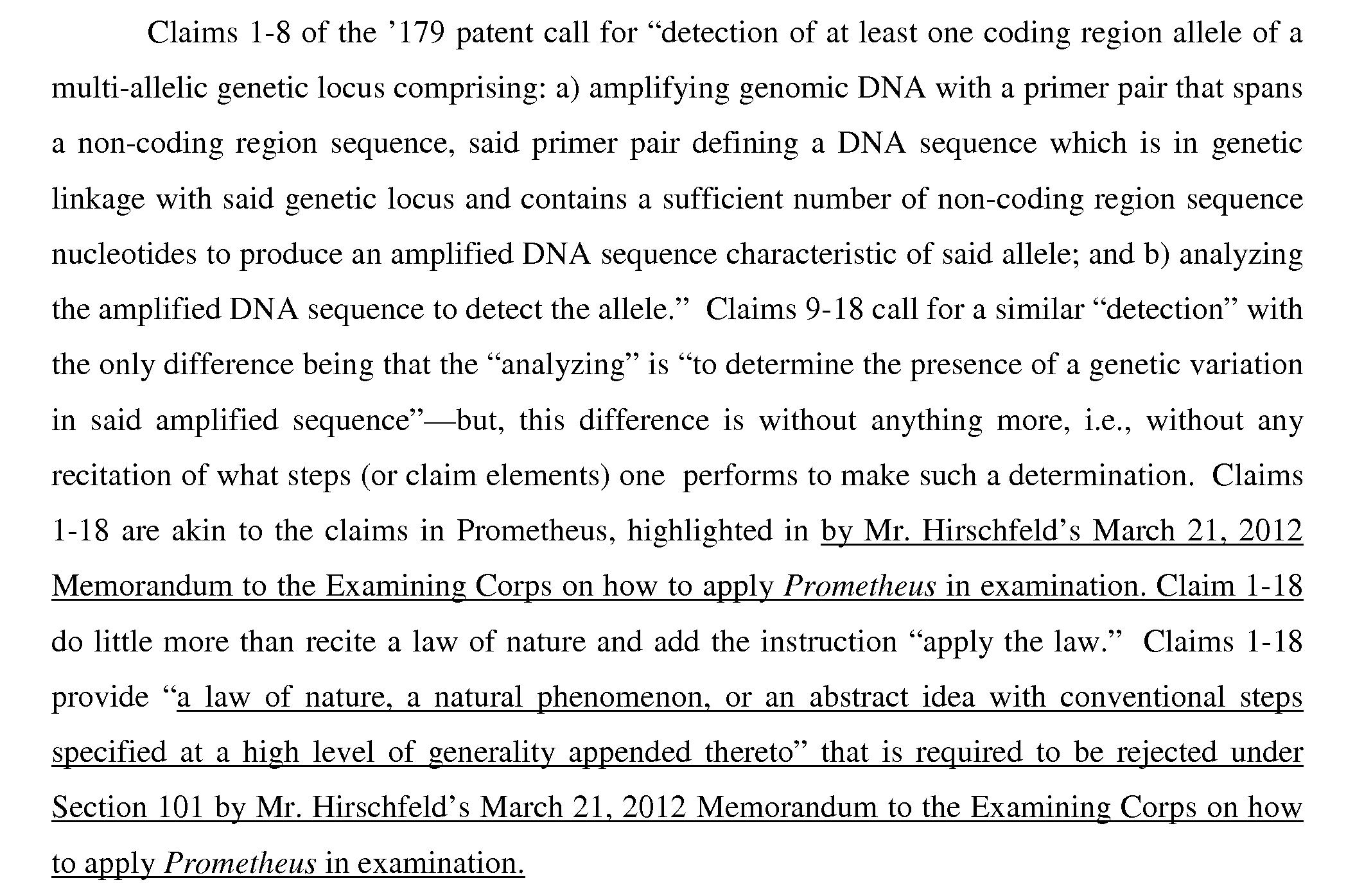
The filing (here) continues by stating that the ‘179 Patent claims are “akin to the claims in Prometheus, explaining:101a

As made clear in MPEP 2258 (B), issues relating to 35 U.S.C. § 101 are not considered in patent reexamination. While Merial is not advancing a 101 rejection per se, the USPTO would have to agree that the claims of the ‘179 patent fail to meet 101 in order to reexamine them in the manner requested; this is not going to happen. Instead the 101 aspect of the request will simply be ignored.

So, aside from inexperience, why would a Requester go through the trouble of submitting all of this extraneous 101 discussion? 

Often times, reexamination requests will include litigation inspired theories that Requesters are well aware will be of no consequence to the USPTO. Instead, such discussions are typically provided for the benefit of a judge in the parallel proceeding (i.e., where the filing is introduced as a status update or the like); perhaps such is the case here.  Merial and Genetic Technologies are currently litigating the patent in Delaware. In some circumstances, filings of this ilk are referred to the Office of Patent Legal Administration (OPLA) for vacating of the filing date. (such as where inequitable conduct is alleged. See 95/001,259 (2/12/10)) Thus, such filing strategies are not without risk, and are best avoided.

Here, the 101 discussion is quite distracting, spanning a significant portion of the early discussion. Likewise, as Merial’s other arguments with respect to the 112 support are not based on declaration evidence, but just attorney argument, the request strategy could very well backfire by dooming the whole request to an outright denial.

As a result of the America Invents Act, challengers will be able to properly allege 101 deficiencies via a Post Grant Review (PGR), or Transitional Program for Covered Business Method Patents (TCCBMP) on or after September 16, 2012; until then….don’t try this at home.

USPTO Program Ends June 16th

Some pre-grant news today….as detailed previously, the USPTO has launched a new, internal pilot program entitled “After Final Consideration Pilot” (AFCP). The program is designed to foster compact prosecution by encouraging examiner entry of an amendment submitted in response to a final rejection, in limited situations.

If you have submitted such a filing to the USPTO since March 26th, the examiner will determine whether he or she should take advantage of the additional examining time authorized by the pilot to consider the response. Examiners will use their professional judgment to decide whether the response can be fully considered, including any additional search required, within a three hour time limit in order to determine whether the application can be allowed. There is no need to file any special request for consideration of an amendment under this pilot program.

Unfortunately, this program will end on June 16th, (which seems rather short lived in my opinion to get meaningful data). Going forward, the effectiveness of the program will be evaluated relative to the number of RCE filings avoided. While the program certainly cannot hurt, the continued viability of the program is more likely a question of cost effectiveness. 

Speaking of after final practice, there is an interesting study authored by Kip Werking (posted on IPWatchdog) that explains BPAI success rates for applicants are closer to 75% rather than the 33% reported by the USPTO. The study points out that, when taking into account appeals that are pulled back by the examiner prior to Board decision (i.e., reopening of prosecution after filing of an appeal brief), that such is tantamount to a Board reversal. ( study 75-the-real-rate-of-patent-applicant-success-on-appeal/id=24525/”>here

Item of Information Limit Accounts for Practical Realities

Supplemental Examination (SE) is a mechanism of the AIA that is designed to effectively cure inequitable conduct via a new post grant proceeding of the USPTO. This mechanism, effective September 16, 2012 will be available to all issued patents.

In operation, SE allows a Patentee to submit very detailed explanations of potential issues that may render the patent invalid under an inequitable conduct theory. Upon submission of Substantial New Questions of patentability (SNQs) detailing such potential defects, the Office will reconsider or correct such information; that is to say the Office will perform a “supplemental examination.” Once such issues are considered, any patent issuing as a result of the SE would be free of inequitable conduct charges based on the same issues considered in the SE.

In the proposed rules to implement SE, the USPTO has limited the number of “items of information” for presenting a SNQ to 10. Public comments directed to this implementation detail have been largely negative.

A few days back, the Director more or less made clear that this limitation will remain in the Final rules.

In justifying the 10 item limitation, the Director explained:

The supplemental examination procedure was designed to provide patentees with a quick and decisive examination of items that were overlooked during the patent’s original prosecution. So quick in fact, that the AIA set a three-month period for us to conduct and conclude a supplemental examination after a request is filed. That’s just three months to determine if any of the items of information raise a substantial new question of patentability.

In order to meet this timeframe, we have proposed a limit of 10 items of information that a patent owner can submit to the USPTO for consideration in each request. The purpose of this limit is to strike a balance between the needs of the patent owner and the ability of the Office to timely conclude the proceeding. That said, we did not limit the number of issues that these 10 items of information can raise, nor did we limit the number of separate supplemental reexamination requests that a patentee can file.

Following publication of the proposed rules, the Office received a number of suggestions requesting us to accept more than 10 items of information in a single supplemental examination request. While we’re still considering this and all of the other input we have received, I wanted to share with you the factors the Office took into consideration in proposing a limit of 10 submissions.

First, far fewer than 10 prior art documents form the basis for most inequitable conduct allegations. In fact, we are unaware of any publicly reported inequitable conduct dispute involving more than 10 items of information – if you know of one, please let us know. Second, in over 85 percent of the requests for ex parte reexamination, the requester cites 10 or fewer items for consideration by the Office. Third, the Office was very mindful of the time necessary for examiners to analyze the items of information submitted, particularly since the items are not limited to patents and printed publications, and each item may raise multiple issues.

Accordingly, limiting the number of items of information to 10 will help the USPTO establish a procedure that is not only practical, but also one enabling an examiner to fully, comprehensively, and timely analyze all submitted items of information and issues to accurately determine whether there is a substantial new question of patentability.

The Office would seem to be on solid ground here.

A more interesting question is, post-Therasensewhether or not SE is a risk worth taking at all.

Transitional Program for Covered Business Method Patents (TPCBMP)

The Transitional Program for Covered Business Method Patents, (TPCBMP) will be implemented by the USPTO on September 16, 2012. The new post grant option essentially provides that any “covered business method patent” may be challenged under the same procedures and standards applied in Post Grant Review (PGR) proceedings. The TPCBMP will sunset 8 years from implementation, hence the “transitional” label.

The major differences between PGR and TPCBMP relate to patent eligibility and estoppel.

With respect to estoppel, PGR estoppel attaches to any ground that the petitioner raised, or reasonably could have raised during the PGR. On the other hand, TPCBMP estoppel is only limited to issues actually raised during the proceeding.

The legislation defines a “covered business method patent” in general terms, as follows:

a patent that claims a method or corresponding apparatus for performing data processing or other operations used in the practice, administration, or management of a financial product or service, except that the term does not include patents for technological inventions.

As can be appreciated, the definition of “covered business method patent” is of great interest to some of the leading U.S. innovators. Recently, the Senator (Schumer D-NY) that introduced the TPCBMP to the patent reform legislation urged the USPTO to adopt a very liberal definition of “covered business method patent.”

In his letter to the USPTO (here), Senator Schumer attempts to rebut the position of “commenters” (which would include many major technology companies), arguing that:

[M]any of the problematic business method patents this program is intended to weed out are asserted against small businesses, especially internet startups. This program was designed to target problematic patents, regardless of the business identity of the party against whom they are asserted. The limitation commenters suggest is not only contrary to basic common sense and fairness, it is plainly refuted by the record [discussing argument that the TPCBMPs should be limited to financial industry].

.           .              .         .

The term “technological invention” should not provide a haven for clever lawyers. Arguments that the “technological invention” exception is broad are false. As stated in the legislative history, “Clever drafting of patent application should not allow a patent holder to avoid PTO review under [the program]. . . .many of the problematic patents this program targets involve practices that are in widespread use by companies through their digital platforms – an often-cited example is a patent for one-click check-out. A broad construction of the technological invention exception would exclude any patent that involved the internet, and would render the program effectively meaningless. For these reasons, the commenters’ suggestions to categorically exclude particular types of patents from the program should be rejected.

Yet, the proposed rules make clear that the USPTO is not proposing an exclusion of patents that involve the Internet (and would certainly disregard any such comment). In fact, such is explicitly stated in the Practice Guide for the Proposed Trial Rules:

The following claim drafting techniques would not typically render a patent a technological invention:

(a) Mere recitation of known technologies, such as computer hardware, communication or computer networks, software, memory, computer readable storage medium, scanners, display devices or databases, or specialized machines, such as an ATM or point of sale device.

(emphasis added)

Senator Schumer’s “clever lawyer” concern is more appropriately directed to those that will be attempting to shoe horn otherwise valuable, technological inventions into an overly expansive definition of “covered business method” come September 2012. That is to say, with virtually no meaningful estoppel, and a clear mandate by Congress to have such litigation disputes stayed in favor of TPCBMP proceedings, the USPTO would best serve industry innovators by erring on the side of caution.