
Inter Partes Review, 5 Months to a First Action?Should the proposed patent reform legislation pass into law, inter partes reexamination will gradually cease to exist. In place of inter partes patent reexamination will be an entirely new mechanism known as Inter Partes Review. Inter Partes Review will not be conducted by patent examiners of the Central Reexamination Unit, but instead by the Administrative Patent Judges of the Patent Trial & Appeal Board (now known as the BPAI). As the new proceeding is conducted by APJs, limited discovery practices will be provided. Beside these procedural changes, the substantive analysis remains largely the same. …at least in H.R. 1249.In H.R. 1249, the Substantial New Question of Patentability (SNQ) standard is substituted for the “likelihood of success” standard of Senate bill S.23. So, in order to initiate an Inter Partes Review under the House Bill, the same SNQ standard of inter partes patent reexamination is used.While the House bill removed the heightened standard (i.e., likelihood of success) in favor of the much more liberal SNQ standard (i.e., important to a reasonable examiner), the Senate provision providing for a preliminary Patentee response to a request for Inter Partes Review remains in the bill. In essence, Inter Partes Review of H.R. 1249 is substantive ly the same as inter partes patent reexamination, with the added provision of a patent owner statement on the front end. In the Senate Bill, a preliminary response provided a meaningful opportunity for patentees to rebut the ‘likelihood of success” showing of the request. Now that the House Bill has reverted to the SNQ standard, the preliminary response may provide nothing more than dead time to the front end of the Inter Partes Review. The preliminary response provision of H.R. 1249 reads as follows:Sec. 313. Preliminary response to petition(a) Preliminary Response- If an inter partes review petition is filed under section 311, the patent owner shall have the right to file a preliminary response within a time period set by the Director.(b) Content of Response- A preliminary response to a petition for inter partes review shall set forth reasons why no inter partes review should be instituted based upon the failure of the petition to meet any requirement of this chapter.Sec. 314. Institution of inter partes review(a) Threshold- The Director may not authorize an inter partes review to commence unless the Director determines that the information presented in the petition filed under section 311 and any response filed under section 313 shows that a substantial new question of patentability exists. (emphasis added)History has shown that roughly 96% of inter partes patent reexaminations are granted, meaning an SNQ is almost always found. Due to the relatively low standard for finding an SNQ, it seems unlikely that a patentee would deem it worthwhile to argue the issue. Whether an SNQ is presented in the request is quite different from whether or not prima facie rejections are presented. As such, one would expect the office to follow the statute and deny consideration of arguments directed to proposed rejections as premature.Although neither the House nor Senate bills identify a time frame to submit such a preliminary response, the Post Grant Review mechanism provides 2 months. Thus, it is safe to assume a similar time frame for Inter Partes Review. The date for determining whether or not the proceeding should be conducted is “within three months” of the receipt of the preliminary response, or the last date upon which one would be due. So, a first office action would not be possible until at least 5 months from filing of an Inter Partes review.Currently, as there is no patent owner statement permitted in inter partes patent reexamination, office actions have issued as quickly as 2 months. Notably, Congress has set a 12 month time frame to conclude an Inter Partes Review (18 months maximum); front loading needless delay would not seem to comport with that intent.  As the saying goes, if it aint broke, don’t fix

Should the proposed patent reform legislation pass into law, inter partes reexamination will gradually cease to exist. In place of inter partes patent reexamination will be an entirely new mechanism known as Inter Partes Review.

Inter Partes Review will not be conducted by patent examiners of the Central Reexamination Unit, but instead by the Administrative Patent Judges of the Patent Trial & Appeal Board (now known as the BPAI). As the new proceeding is conducted by APJs, limited discovery practices will be provided. Beside these procedural changes, the substantive analysis remains largely the same. …at least in H.R. 1249.

In H.R. 1249, the Substantial New Question of Patentability (SNQ) standard is substituted for the “likelihood of success” standard of Senate bill S.23. So, in order to initiate an Inter Partes Review under the House Bill, the same SNQ standard of inter partes patent reexamination is used.

While the House bill removed the heightened standard (i.e., likelihood of success) in favor of the much more liberal SNQ standard (i.e., important to a reasonable examiner), the Senate provision providing for a preliminary Patentee response to a request for Inter Partes Review remains in the bill. In essence, Inter Partes Review of H.R. 1249 is substantive ly the same as inter partes patent reexamination, with the added provision of a patent owner statement on the front end. 

In the Senate Bill, a preliminary response provided a meaningful opportunity for patentees to rebut the ‘likelihood of success” showing of the request. Now that the House Bill has reverted to the SNQ standard, the preliminary response may provide nothing more than dead time to the front end of the Inter Partes Review.  The preliminary response provision of H.R. 1249 reads as follows:

Sec. 313. Preliminary response to petition

(a) Preliminary Response- If an inter partes review petition is filed under section 311, the patent owner shall have the right to file a preliminary response within a time period set by the Director.

(b) Content of Response- A preliminary response to a petition for inter partes review shall set forth reasons why no inter partes review should be instituted based upon the failure of the petition to meet any requirement of this chapter.

Sec. 314. Institution of inter partes review

(a) Threshold- The Director may not authorize an inter partes review to commence unless the Director determines that the information presented in the petition filed under section 311 and any response filed under section 313 shows that a substantial new question of patentability exists. (emphasis added)

History has shown that roughly 96% of inter partes patent reexaminations are granted, meaning an SNQ is almost always found. Due to the relatively low standard for finding an SNQ, it seems unlikely that a patentee would deem it worthwhile to argue the issue. Whether an SNQ is presented in the request is quite different from whether or not prima facie rejections are presented. As such, one would expect the office to follow the statute and deny consideration of arguments directed to proposed rejections as premature.

Although neither the House nor Senate bills identify a time frame to submit such a preliminary response, the Post Grant Review mechanism provides 2 months. Thus, it is safe to assume a similar time frame for Inter Partes Review. The date for determining whether or not the proceeding should be conducted is “within three months” of the receipt of the preliminary response, or the last date upon which one would be due. So, a first office action would not be possible until at least 5 months from filing of an Inter Partes review.

Currently, as there is no patent owner statement permitted in inter partes patent reexamination, office actions have issued as quickly as 2 months. Notably, Congress has set a 12 month time frame to conclude an Inter Partes Review (18 months maximum); front loading needless delay would not seem to comport with that intent.  

As the saying goes, if it aint broke, don’t fix it.

Additional Grounds for Challenging Patents in Proposed Post Grant Review LegislationOn Wednesday, the House of Representatives formally introduced H.R. 1249, as previewed here last Friday. The bill includes some changes to the proposed post grant review and inter partes review proceedings.The two major changes being discussed in the House are: (1) The expansion of the Post Grant Review window to 12 months (S.23 previously provided 9 months); and (2) The reemergence of the SNQ standard as the threshold determination in the proposed inter partes review proceeding (S.23 previously proposed a likelihood of success standard). The Bio/Pharma community has been clear that the House’s adoption of the SNQ standard for inter partes review is not a welcomed change.Yet, the “additional grounds” subsection of postgrant review may prove much more troublesome for the bio/pharma community.Both the Senate and House bills prevent a post grant review proceeding form going forward unless the request demonstrates that “it is more likely than not that at least 1 of the claims challenged in the petition is unpatentable.” (Sec. 324 subsection (a))Subsection (b) provides:(b) ADDITIONAL GROUNDS–The determination required under subsection (a) may also be satisfied by a showing that the petition raises a novel or unsettled legal question that is important to other patents or patent applications.Subsection (b) clearly addresses the concern that subsection (a) would, by virtue of the “more likely than not” outcome standard, prevent challenges on unproven theories. But, is subsection (b) necessary?  Is the USPTO the best venue for such novel legal challenges?  What kinds of “theories” would fall into this category anyway?It is hard to imagine too many novel or untested legal theories that are “important to other patents or patent applications” that would not in some way involve application of 35 U.S.C. § 101. Arguing against the patentability of gene sequencing, aspects of human cloning, genome mapping, and the like would seem to be the types of “novel or untested” legal theories having a wide ranging impact on other patents. Subsection (b) is nothing more than an invitation to take these battles to the USPTO.It seems to me that untested legal theories that have far reaching public policy implications are best left to the courts and legislators. The USPTO is best equipped to review issues of technology and prior art, not novel legal questions.Moreover, this legislation is a game changer with respect to the Board of Patent Appeals & Interferences (BPAI). The USPTO will have enough on their plate transitioning to a Patent Trial & Appeal Board to accommodate inter partes review, while simultaneously accommodating an entirely new procedure, post grant review. Encouraging the public to pursue novel and untested legal theories during this time of change seems more than a bit misguided. Clearly, the post grant aspects of the bill will be hotly debated in the coming weeks. Yet, not all aspects of the proposed post grant review mechanism are problematic for bio/pharma.  Interestingly, since the grounds of post grant review are based on the statutory defenses of 35 U.S.C. § 282, instead of patent reexamination’s “patents and printed publications,” obviousness-type double patenting is seemingly excluded from post grant review. The absence of this ground is a boon to the bio/pharma community. Many patent reexaminations that involve drug patents include such rejections with the hopes of limiting patent term.More on the various post grant options of the legislation next week.  

On Wednesday, the House of Representatives formally introduced H.R. 1249, as previewed here last Friday. The bill includes some changes to the proposed post grant review and inter partes review proceedings.

The two major changes being discussed in the House are: (1) The expansion of the Post Grant Review window to 12 months (S.23 previously provided 9 months); and (2) The reemergence of the SNQ standard as the threshold determination in the proposed inter partes review proceeding (S.23 previously proposed a likelihood of success standard). The rn-with-inter-partes-review-changes/”>Bio/Pharma community has been clear that the House’s adoption of the SNQ standard for inter partes review is not a welcomed change.

Yet, the “additional grounds” subsection of postgrant review may prove much more troublesome for the bio/pharma community.

Both the Senate and House bills prevent a post grant review proceeding form going forward unless the request demonstrates that “it is more likely than not that at least 1 of the claims challenged in the petition is unpatentable.” (Sec. 324 subsection (a))

Subsection (b) provides:

(b) ADDITIONAL GROUNDS–The determination required under subsection (a) may also be satisfied by a showing that the petition raises a novel or unsettled legal question that is important to other patents or patent applications.

Subsection (b) clearly addresses the concern that subsection (a) would, by virtue of the “more likely than not” outcome standard, prevent challenges on unproven theories. 

But, is subsection (b) necessary?  Is the USPTO the best venue for such novel legal challenges?  What kinds of “theories” would fall into this category anyway?

It is hard to imagine too many novel or untested legal theories that are “important to other patents or patent applications” that would not in some way involve application of 35 U.S.C. § 101. Arguing against the patentability of gene sequencing, aspects of human cloning, genome mapping, and the like would seem to be the types of “novel or untested” legal theories having a wide ranging impact on other patents. Subsection (b) is nothing more than an invitation to take these battles to the USPTO.

It seems to me that untested legal theories that have far reaching public policy implications are best left to the courts and legislators. The USPTO is best equipped to review issues of technology and prior art, not novel legal questions.

Moreover, this legislation is a game changer with respect to the Board of Patent Appeals & Interferences (BPAI). The USPTO will have enough on their plate transitioning to a Patent Trial & Appeal Board to accommodate inter partes review, while simultaneously accommodating an entirely new procedure, post grant review. Encouraging the public to pursue novel and untested legal theories during this time of change seems more than a bit misguided. 

Clearly, the post grant aspects of the bill will be hotly debated in the coming weeks. 

Yet, not all aspects of the proposed post grant review mechanism are problematic for bio/pharma.  

Interestingly, since the grounds of post grant review are based on the statutory defenses of 35 U.S.C. § 282, instead of patent reexamination’s “patents and printed publications,” obviousness-type double patenting is seemingly excluded from post grant review. The absence of this ground is a boon to the bio/pharma community. Many patent reexaminations that involve drug patents include such rejections with the hopes of limiting patent term.

More on the various post grant options of the legislation next week. 


Petition or Appeal?–Pursuit of SNQ Denial at the USPTOWhen pursuing inter partes patent reexamination, denial of a Substantial New Question of Patentability (SNQ) by the USPTO can be especially troubling to third party requesters. This is because a third party is estopped from asserting in litigation the “invalidity of any claim finally determined to be valid and patentable on any ground which the third-party requester raised or could have raised during the inter partes reexamination proceedings.” 35 U.S.C. § 315(c).Denied SNQs raise the fear of potential district court estoppel relative to the prior art underlying the denied SNQ. For this reason, third parties will almost always dispute such denials internal to the USPTO–even where the claims of the patent remain rejected based upon other SNQs of the same request.But, what is the appropriate vehicle for such a dispute, petition or appeal? The answer to this question will depend upon whether or not the denied SNQ pertains to a claim that is being actively reexamined on other grounds. As explained by an expanded panel of the Board of Patent Appeals & Interferences (BPAI) yesterday in Belkin International et al., v. Optimumpath LLC, the denial of an SNQ in inter partes patent reexamination is  petitionable, not appealable. In Belkin U.S. Patent 7,035,281 was reexamined (95/001,089). The request was granted as to claims 1-3 and 8-10, but denied as to claims 4-7 and 11-31.The denial of the SNQs applied to claims 4-7 and 11-31 was petitioned to the Director of the Central Reexamination Unit. Upon reconsideration, the Director refused to reverse the examiner. During prosecution, the rejection of claims 1-3 and 8-10 was later withdrawn by the examiner. Thereafter, the third party appealed the withdrawn rejection and the denial of the SNQs. On appeal, the BPAI affirmed the examiner’s decision to withdraw the rejection and confirm the patentability of claims 1-3 and 8-10. As to the appeal of the denied SNQs, the BPAI explained that such issues may not be appealed to the Board. . . . 35 U.S.C. § 312 states that the Director makes such determinations (of whether a substantial new question of patentability exists) and that the determination “by the Director . . . shall be final and non-appealable.” Only when the Director makes the determination that a substantial new question of patentabilityaffecting a claim of a patent is raised (i.e., that a substantial new question of patentability exists for a particular claim) shall an inter partes reexamination of the claim(s) in question be performed for resolution of the question (35 U.S.C. § 313). Therefore, on the other hand, when the Director makes a determination that a substantial new question of patentability affecting a particular claim is not raised, the Director does not order inter partes reexamination of the patent with respect to those claims. Under those circumstances, no reexamination is performed with respect to those proposed substantial new questions of patentability. Also, as pointed out above, the Director’s determination that no substantial new question of patentability was established for any particular claim(s) is final and non-appealable (35 U.S.C. § 312(c)).Since, under 35 U.S.C. § 312 and 35 U.S.C. § 313, reexamination of the patent claims in question cannot proceed when the Director makes a determination that a substantial new question of patentability has not been raised for those claims and that the Director’s determination is non-appealable, no final decision, whether favorable or unfavorable, can be rendered pertaining to those claims. Under 35 U.S.C. § 315(b), a third-party requester may appeal with respect to any “final decision favorable to the patentability” of disputed claims. However, as described above, if the Director makes the non-appealable determination that no substantial new question of patentability has been raised, then reexamination is not performed for those claims in question with respect to the corresponding prior art references. There cannot have been a final decision (either favorable or unfavorable) on the patentability of the claims in question under 35 U.S.C. § 315(b), the claims not having been reexamined in the first place for lack of a substantial new question of patentability. (emphasis added)The decision continues on to explain that the denial of SNQs is propoerly pursued by petition to the Director (which Belkin filed to no avail; 37 C.F.R. § 1.927). Note that had an SNQ been found but the corresponding rejections not adopted, appeal of non-adopted rejections would have been appropriate.Of course, a patent owner’s seeking to reverse an accepted SNQ in ex parte patent reexamination may pursue the matter to the BPAI

When pursuing inter partes patent reexamination, denial of a Substantial New Question of Patentability (SNQ) by the USPTO can be especially troubling to third party requesters. This is because a third party is estopped from asserting in litigation the “invalidity of any claim finally determined to be valid and patentable on any ground which the third-party requester raised or could have raised during the inter partes reexamination proceedings.” 35 U.S.C. § 315(c).

Denied SNQs raise the fear of potential district court estoppel relative to the prior art underlying the denied SNQ. For this reason, third parties will almost always dispute such denials internal to the USPTO–even where the claims of the patent remain rejected based upon other SNQs of the same request.

But, what is the appropriate vehicle for such a dispute, petition or appeal? The answer to this question will depend upon whether or not the denied SNQ pertains to a claim that is being actively reexamined on other grounds.

As explained by an expanded panel of the Board of Patent Appeals & Interferences (BPAI) yesterday in Belkin International et al., v. Optimumpath LLC, the denial of an SNQ in inter partes patent reexamination is  petitionable, not appealable. In Belkin U.S. Patent 7,035,281 was reexamined (95/001,089). The request was granted as to claims 1-3 and 8-10, but denied as to claims 4-7 and 11-31.

The denial of the SNQs applied to claims 4-7 and 11-31 was petitioned to the Director of the Central Reexamination Unit. Upon reconsideration, the Director refused to reverse the examiner. 

During prosecution, the rejection of claims 1-3 and 8-10 was later withdrawn by the examiner. Thereafter, the third party appealed the withdrawn rejection and the denial of the SNQs. 

On appeal, the BPAI affirmed the examiner’s decision to withdraw the rejection and confirm the patentability of claims 1-3 and 8-10. As to the appeal of the denied SNQs, the BPAI explained that such issues may not be appealed to the Board.

 . . . 35 U.S.C. § 312 states that the Director makes such determinations (of whether a substantial new question of patentability exists) and that the determination “by the Director . . . shall be final and non-appealable.” Only when the Director makes the determination that a substantial new question of patentabilityaffecting a claim of a patent is raised (i.e., that a substantial new question of patentability exists for a particular claim) shall an inter partes reexamination of the claim(s) in question be performed for resolution of the question (35 U.S.C. § 313). Therefore, on the other hand, when the Director makes a determination that a substantial new question of patentability affecting a particular claim is not raised, the Director does not order inter partes reexamination of the patent with respect to those claims. Under those circumstances, no reexamination is performed with respect to those proposed substantial new questions of patentability. Also, as pointed out above, the Director’s determination that no substantial new question of patentability was established for any particular claim(s) is final and non-appealable (35 U.S.C. § 312(c)).

Since, under 35 U.S.C. § 312 and 35 U.S.C. § 313, reexamination of the patent claims in question cannot proceed when the Director makes a determination that a substantial new question of patentability has not been raised for those claims and that the Director’s determination is non-appealable, no final decision, whether favorable or unfavorable, can be rendered pertaining to those claims. Under 35 U.S.C. § 315(b), a third-party requester may appeal with respect to any “final decision favorable to the patentability” of disputed claims. However, as described above, if the Director makes the non-appealable determination that no substantial new question of patentability has been raised, then reexamination is not performed for those claims in question with respect to the corresponding prior art references. There cannot have been a final decision (either favorable or unfavorable) on the patentability of the claims in question under 35 U.S.C. § 315(b), the claims not having been reexamined in the first place for lack of a substantial new question of patentability. (emphasis added)

The decision continues on to explain that the denial of SNQs is propoerly pursued by petition to the Director (which Belkin filed to no avail; 37 C.F.R. § 1.927). Note that had an SNQ been found but the corresponding rejections not adopted, appeal of non-adopted rejections would have been appropriate.

Of course, a patent owner’s seeking to reverse an accepted SNQ in ex parte patent reexamination may pursue the matter to the BPAI.

Ronald Katz & Sorenson Research Appeals DecidedFor those keeping score, the infamous patent portfolio of Ronald Katz continues to wither under the pressure of patent reexamination. Previously, I pointed out the problems patent reexamination has created for the Katz portfolio in parallel litigation. Likewise, last year, an expanded BPAI panel clarified their decision to reject claims in Katz Patent 5,561,707 by explaining the proper analysis for construing expired patent claims during patent reexamination.Yesterday, the BPAI shot down claims of yet another patent of the Katz portfolio (5,815,551) in Ex Parte Ronald Katz Technology Licensing L.P. In the most recent appeal, it appears Katz pursued very similar arguments to that rejected by the BPAI last year with respect to expired patents.Another infamous troll, Sorenson Research & Development Trust, fared much better yesterday at the BPAI.In Ex Parte Jens Erik Sorenson (4,935,184) yet another expired patent was considered by the BPAI. However, rather than disputing the standard applied to such patents during reexamination, Sorenson disputed the inherency finding of the examiner relative to a key claim term. The Board explained their reversal of the examiner as follows:[C]laim 1 requires that the stabilizing regions provided by the solidified first plastic material must rigidly secure the first common mode part in position in relation to the second complementary mold part.We are of the opinion that the Examiner has not provided a sufficient basis with factual underpinnings to support the position that Moscicki inherently discloses this aspect of claim 1. . . . . [T]hough Moscicki’s first plastic material may impede some movement of the first common mold part in relation to the second complementary mold part, it may not be sufficiently solidified to “rigidly secure” the first common mold part in position in relation to the second complementary mold part. Indeed, the Kazmer Declaration provides evidence that Moscicki’s first plastic material would not “rigidly secure” as required by claim 1.The Sorenson patent expired in February of 2008, thus it would appear to have only 3 years of enforceability remaining (i.e., 6 years beyond expiration). Since any renewed request for patent reexamination is unlikely to reach a final conclusion before that time, it seems that this licensing campaign will contin

For those keeping score, the infamous patent portfolio of Ronald Katz continues to wither under the pressure of patent reexamination. Previously, I pointed out the problems patent reexamination has created for the Katz portfolio in parallel litigation. Likewise, last year, an expanded BPAI panel clarified their decision to reject claims in Katz Patent 5,561,707 by explaining the proper analysis for construing expired patent claims during patent reexamination.

Yesterday, the BPAI shot down claims of yet another patent of the Katz portfolio (5,815,551) in Ex Parte Ronald Katz Technology Licensing L.P. In the most recent appeal, it appears Katz pursued very similar arguments to that rejected by the BPAI last year with respect to expired patents.

Another infamous troll, Sorenson Research & Development Trust, fared much better yesterday at the BPAI.

In Ex Parte Jens Erik Sorenson (4,935,184) yet another expired patent was considered by the BPAI. However, rather than disputing the standard applied to such patents during reexamination, Sorenson disputed the inherency finding of the examiner relative to a key claim term. The Board explained their reversal of the examiner as follows:

[C]laim 1 requires that the stabilizing regions provided by the solidified first plastic material must rigidly secure the first common mode part in position in relation to the second complementary mold part.

We are of the opinion that the Examiner has not provided a sufficient basis with factual underpinnings to support the position that Moscicki inherently discloses this aspect of claim 1. . . . . [T]hough Moscicki’s first plastic material may impede some movement of the first common mold part in relation to the second complementary mold part, it may not be sufficiently solidified to “rigidly secure” the first common mold part in position in relation to the second complementary mold part. Indeed, the Kazmer Declaration provides evidence that Moscicki’s first plastic material would not “rigidly secure” as required by claim 1.

The Sorenson patent expired in February of 2008, thus it would appear to have only 3 years of enforceability remaining (i.e., 6 years beyond expiration). Since any renewed request for patent reexamination is unlikely to reach a final conclusion before that time, it seems that this licensing campaign will continue.

USPTO Forced to Turn a Blind Eye to Support Issues in Patent ReexaminationLast year I explained that the patent reexamination statutes preclude proper review of originally issued means-plus-function claims (i.e., claims drafted to invoke 35 U.S.C. § 112 6th paragraph). This is because a proper examination of a means-plus-function claim requires consideration of the structure and acts described in the specification. Once such acts/structure are identified, then a determination is made as to the equivalence of the acts/structure of the cited prior art. Yet, where support is deficient for MPF claims, a rejection pursuant to 35 U.S.C. § 112 2nd is not possible.  As a reminder, 35 U.S.C. § 112 cannot be used to reject original claims in patent reexamination. Such a rejection is inappropriate as it would not be based on a “patent or printed publication as required by 35 U.S.C. § 301. See MPEP 2258 (II). Thus, in cases where the specification support is deficient, the USPTO must ignore this deficiency during patent reexamination. Instead, the claims are examined by turning a blind eye to the indefiniteness issue and applying the familiar broadest reasonable interpretation standard. In applying the BRI standard, the scope of MPF claims are broadened beyond their relatively narrower, statutorily defined scope–which is limited to the specific act/structures of the specification and equivalents. Confusingly, enlarging the scope of a claim in patent reexamination is also in direct conflict with a patent reexamination statute, 35 U.S.C. § 305. This patent reexamination paradox was most recently demonstrated in Ex Parte Avid Identifications Systems Inc. (U.S. Patent 5,499,017)Although the Patentee in Avid appeared to identify structure in their brief, the Board indicated that the cited structure did not clearly correspond to the claim language, explaining:In the absence of any specific structure in the Specification corresponding to the claimed “means for extracting data,” we construe the “means” as including any structure that can be represented by a box that performs the recited function or equivalents thereof. (emphasis added).If this had been an appeal of a patent application, a 112 2nd paragraph rejection would have certainly been issued, not so for patent reexamination.Ultimately, the Avid appeal affirmed art rejections of the MPF claims. As such, this claim interpretation conundrum may seem harmless. Still, in appeals where the art rejections of MPF claims are reversed, application of the BRI standard effectively broadens the scope of the reexamined claims– in violation of the statute. Perhaps more significantly, the creation of such a record is unnecessarily misleading the public as to the proper scope of such claims.MPF support issues are increasingly case dispositive in patent litigation.  Aristocrat Techs. Austl. Pty Ltd. v. Inter. Game Tech., 521 F.3d 1328 (Fed.Cir. 2008) See also Blackboard, Inc. v. Desire2Learn Inc., No. 2008-1368, slip op. at 21 (Fed. Cir. July 27, 2009).Interestingly, in a different patent reexamination context, a challenge to 112 written description is permitted. For example, if the patent subject to the reexamination request claims priority to a parent case, intervening prior art may be presented together with an argument that the priority claim is ineffective as to written description. Presumably, the 112 analysis is permitted in this context as the request is not attacking 112 support of the reexamined patent, but instead, corresponding disclosure of a parent. Therefore, the SNQs presented are still based on patents and printed publications as they do not explore 112 issues of the underlying specification.It seems that MPF claims cannot be properly reexamined at the USPTO until the conflict between the above noted patent reexamination statutes is remedied. Although the current patent reform legislation before Congress addresses many aspects of post grant practice, this issue remains outstandi

Last year I explained that the patent reexamination statutes preclude proper review of originally issued means-plus-function claims (i.e., claims drafted to invoke 35 U.S.C. § 112 6th paragraph). This is because a proper examination of a means-plus-function claim requires consideration of the structure and acts described in the specification. Once such acts/structure are identified, then a determination is made as to the equivalence of the acts/structure of the cited prior art. Yet, where support is deficient for MPF claims, a rejection pursuant to 35 U.S.C. § 112 2nd is not possible.  

As a reminder, 35 U.S.C. § 112 cannot be used to reject original claims in patent reexamination. Such a rejection is inappropriate as it would not be based on a “patent or printed publication as required by 35 U.S.C. § 301. See MPEP 2258 (II). Thus, in cases where the specification support is deficient, the USPTO must ignore this deficiency during patent reexamination. Instead, the claims are examined by turning a blind eye to the indefiniteness issue and applying the familiar broadest reasonable interpretation standard. 

In applying the BRI standard, the scope of MPF claims are broadened beyond their relatively narrower, statutorily defined scope–which is limited to the specific act/structures of the specification and equivalents. Confusingly, enlarging the scope of a claim in patent reexamination is also in direct conflict with a patent reexamination statute, 35 U.S.C. § 305. This patent reexamination paradox was most recently demonstrated in Ex Parte Avid Identifications Systems Inc. (U.S. Patent 5,499,017)

Although the Patentee in Avid appeared to identify structure in their brief, the Board indicated that the cited structure did not clearly correspond to the claim language, explaining:

In the absence of any specific structure in the Specification corresponding to the claimed “means for extracting data,” we construe the “means” as including any structure that can be represented by a box that performs the recited function or equivalents thereof. (emphasis added).

If this had been an appeal of a patent application, a 112 2nd paragraph rejection would have certainly been issued, not so for patent reexamination.

Ultimately, the Avid appeal affirmed art rejections of the MPF claims. As such, this claim interpretation conundrum may seem harmless. Still, in appeals where the art rejections of MPF claims are reversed, application of the BRI standard effectively broadens the scope of the reexamined claims– in violation of the statute. Perhaps more significantly, the creation of such a record is unnecessarily misleading the public as to the proper scope of such claims.

MPF support issues are increasingly case dispositive in patent litigation.  Aristocrat Techs. Austl. Pty Ltd. v. Inter. Game Tech., 521 F.3d 1328 (Fed.Cir. 2008) See also Blackboard, Inc. v. Desire2Learn Inc., No. 2008-1368, slip op. at 21 (Fed. Cir. July 27, 2009).

Interestingly, in a different patent reexamination context, a challenge to 112 written description is permitted

For example, if the patent subject to the reexamination request claims priority to a parent case, intervening prior art may be presented together with an argument that the priority claim is ineffective as to written description. Presumably, the 112 analysis is permitted in this context as the request is not attacking 112 support of the reexamined patent, but instead, corresponding disclosure of a parent. Therefore, the SNQs presented are still based on patents and printed publications as they do not explore 112 issues of the underlying specification.

It seems that MPF claims cannot be properly reexamined at the USPTO until the conflict between the above noted patent reexamination statutes is remedied. Although the current patent reform legislation before Congress addresses many aspects of post grant practice, this issue remains outstanding.

House to Introduce Modified Bill Early Next Week (UPDATED FRIDAY)With the America Invents Act out of the Senate, the House is expected to introduce a slightly revised version of the bill next week.  House Judiciary Chairman Lamar Smith, (R-TX), is expected to roll out the House version as early as Monday in anticipation of next Wednesday’s hearing of the Subcommittee on Intellectual Property, Competition and the Internet.It appears as though most major substantive provisions will remain unchanged, with a few minor tweaks here and there. It is expected that aspects of the post grant review provision will be altered. It is also rumored that the proposed provision to eliminate USPTO fee diversion may be the subject of significant debate at the Wednesday hearing. This is not surprising considering the House controls the purse strings and may not be in favor of shutting down one of their favorite slush funds.The bill will be introduced on Tuesday, but an advance copy may be found (HERE). Proposed changes include:-Post Grant Review window expanded to 12 months. -Inter Partes Review timing period adjusted to account for expansion of post grant window.-SNQ standard to be used for IPR and post grant review proceedings.-Automatic stay for any DJ action filed by the petitioner of an Inter Partes Review of Post Grant Review.-Sets framework for stay analysis for both the ITC and district courts.There are a few other minor changes, but the above are the main ones. The bill closely track S.23 in all other respects.

With the America Invents Act out of the Senate, the House is expected to introduce a slightly revised version of the bill next week.  House Judiciary Chairman Lamar Smith, (R-TX), is expected to roll out the House version as early as Monday in anticipation of next Wednesday’s hearing of the Subcommittee on Intellectual Property, Competition and the Internet.

It appears as though most major substantive provisions will remain unchanged, with a few minor tweaks here and there. It is expected that aspects of the post grant review provision will be altered. It is also rumored that the proposed provision to eliminate USPTO fee diversion may be the subject of significant debate at the Wednesday hearing. This is not surprising considering the House controls the purse strings and may not be in favor of shutting down one of their favorite slush funds.

The bill will be introduced on Tuesday, but an advance copy may be found (HERE). Proposed changes include:

-Post Grant Review window expanded to 12 months. 

-Inter Partes Review timing period adjusted to account for expansion of post grant window.

-SNQ standard to be used for IPR and post grant review proceedings.

-Automatic stay for any DJ action filed by the petitioner of an Inter Partes Review of Post Grant Review.

-Sets framework for stay analysis for both the ITC and district courts.

There are a few other minor changes, but the above are the main ones. The bill closely track S.23 in all other respects.

Patent Reexamination Cited in Government Brief to Supreme CourtAs noted last week, the amicus briefing in support of respondent i4i was due last Friday at Supreme Court (Microsoft v. i4i). In i4i’s brief, it was emphasized that by providing the patent reexamination statutes, Congress has tacitly acknowledged the clear and convincing standard. In other words, by providing an alternative USPTO forum in which the clear and convincing standard does not apply, the standard used by the district courts was well understood by Congress.This theme was also emphasized in the amicus briefing, however some briefs seem to struggle with the standard to be used for evidence that may not be considered via patent reexamination  Having failed in their patent reexamination efforts, this category of evidence is at the heart of the Microsoft dispute.The government brief (here) explained the Congressional intent argument as follows:Rather than altering the evidentiary standard that governs validity challenges raised in infringement suits, Congress has created and expanded PTO reexamination procedures, which address validity concerns based on published prior art while minimizing the impact on patent holders’ reliance interests. The potential for the expert agency to reconsider its own decision may diminish to some degree the value of an issued patent by increasing the likelihood that the patent will later be found invalid, but it does not create the same uncertainty as would the potential for a lay jury’s invalidation based on a bare preponderance of the evidence. In addition, reexamination gives the patent holder an opportunity to respond to new evidence of invalidity by amending his claims. Unlike an invalidity challenge in litigation, which may completely and permanently extinguish a patent’s value, reexamination provides a more nuanced mechanism that takes reliance interests into account. . . .When the defendant in an infringement suit asserts invalidity based on evidence that was not before the examiner who issued the patent, but that could have been made the basis for a reexamination proceeding, the clear-and-convincing evidence standard furthers Congress’s intent to channel such challenges to the expert agency. Where it is available, use of the reexamination procedure is consistent with the principle that an agency should have the opportunity to reconsider its prior decisions in light of new evidence. (emphasis added)With respect to evidence that could not be considered in patent reexamination (such as the on-sale bar/admission theory of Microsoft in their dispute with i4i), the government also supported the clear and convincing standard, explaining:When an invalidity challenge rests solely on evidence that was not before the PTO and that could not have been the subject of administrative reexamination, the appropriate standard of proof for determining invalidity is less obvious. Ordinarily, when a court reviewing agency action concludes that the agency’s decision was based on incomplete evidence, the proper course is to remand to the agency. . . .. In an infringement suit, however, that option is not available, and both of the options before the court are in some tension with usual administrative-law principles. Applying the preponderance standard that petitioner advocates would permit the jury to determine for itself what the PTO would or should have done had it considered the new evidence, while the clear-and-convincing evidence standard has the practical effect of according deference to an agency decision that did not consider potentially material facts.As between those alternatives, applying the clear-and-convincing-evidence standard across the board reflects the better reading of Section 282 in light of that provision’s text, history, and purposes. Most importantly, the text of Section 282 does not suggest that the standard of proof governing questions of patent validity varies depending on the nature of the evidence that a challenger introduces. Such a variable-proof regime, moreover, would reflect a substantial departure from the way in which evidentiary burdens typically operate. Although juries routinely give different weight to different types of evidence, petitioner identifies no statute under which the standard of proof governing a particular determination depends on the type of evidence that the parties introduce. The Federal Circuit’s longstanding approach to the question presented here, under which evidence that was not before the PTO “may * * * carry more weight and go further toward sustaining the attacker’s unchanging burden” . . .In the Genentech amicus brief (here) the clear and convincing standard is advanced as appropriate for all evidence save that which is inappropriate for patent reexamination (page 26). Under the Genentech scheme, such evidence would be considered under the more liberal preponderance of the evidence standard.Under the Genentech scheme, Microsoft may win the battle but lose the war. That is to say, at stake in this appeal is Microsoft’s opportunity to weaken the patent system across the board. A relatively narrow exception to the clear and convincing standard may be relevant in the i4i dispute, but far short of the radical change sought by Microso

As noted last week, the amicus briefing in support of respondent i4i was due last Friday at Supreme Court (Microsoft v. i4i). In i4i’s brief, it was emphasized that by providing the patent reexamination statutes, Congress has tacitly acknowledged the clear and convincing standard. In other words, by providing an alternative USPTO forum in which the clear and convincing standard does not apply, the standard used by the district courts was well understood by Congress.

This theme was also emphasized in the amicus briefing, however some briefs seem to struggle with the standard to be used for evidence that may not be considered via patent reexamination  Having failed in their patent reexamination efforts, this category of evidence is at the heart of the Microsoft dispute.

The government brief (here) explained the Congressional intent argument as follows:

Rather than altering the evidentiary standard that governs validity challenges raised in infringement suits, Congress has created and expanded PTO reexamination procedures, which address validity concerns based on published prior art while minimizing the impact on patent holders’ reliance interests. The potential for the expert agency to reconsider its own decision may diminish to some degree the value of an issued patent by increasing the likelihood that the patent will later be found invalid, but it does not create the same uncertainty as would the potential for a lay jury’s invalidation based on a bare preponderance of the evidence. In addition, reexamination gives the patent holder an opportunity to respond to new evidence of invalidity by amending his claims. Unlike an invalidity challenge in litigation, which may completely and permanently extinguish a patent’s value, reexamination provides a more nuanced mechanism that takes reliance interests into account. . . .

When the defendant in an infringement suit asserts invalidity based on evidence that was not before the examiner who issued the patent, but that could have been made the basis for a reexamination proceeding, the clear-and-convincing evidence standard furthers Congress’s intent to channel such challenges to the expert agency. Where it is available, use of the reexamination procedure is consistent with the principle that an agency should have the opportunity to reconsider its prior decisions in light of new evidence. (emphasis added)

With respect to evidence that could not be considered in patent reexamination (such as the on-sale bar/admission theory of Microsoft in their dispute with i4i), the government also supported the clear and convincing standard, explaining:

When an invalidity challenge rests solely on evidence that was not before the PTO and that could not have been the subject of administrative reexamination, the appropriate standard of proof for determining invalidity is less obvious. Ordinarily, when a court reviewing agency action concludes that the agency’s decision was based on incomplete evidence, the proper course is to remand to the agency. . . .. In an infringement suit, however, that option is not available, and both of the options before the court are in some tension with usual administrative-law principles. Applying the preponderance standard that petitioner advocates would permit the jury to determine for itself what the PTO would or should have done had it considered the new evidence, while the clear-and-convincing evidence standard has the practical effect of according deference to an agency decision that did not consider potentially material facts.

As between those alternatives, applying the clear-and-convincing-evidence standard across the board reflects the better reading of Section 282 in light of that provision’s text, history, and purposes. Most importantly, the text of Section 282 does not suggest that the standard of proof governing questions of patent validity varies depending on the nature of the evidence that a challenger introduces. Such a variable-proof regime, moreover, would reflect a substantial departure from the way in which evidentiary burdens typically operate. Although juries routinely give different weight to different types of evidence, petitioner identifies no statute under which the standard of proof governing a particular determination depends on the type of evidence that the parties introduce. The Federal Circuit’s longstanding approach to the question presented here, under which evidence that was not before the PTO “may * * * carry more weight and go further toward sustaining the attacker’s unchanging burden” . . .

In the Genentech amicus brief (here) the clear and convincing standard is advanced as appropriate for all evidence save that which is inappropriate for patent reexamination (page 26). Under the Genentech scheme, such evidence would be considered under the more liberal preponderance of the evidence standard.

Under the Genentech scheme, Microsoft may win the battle but lose the war. That is to say, at stake in this appeal is Microsoft’s opportunity to weaken the patent system across the board. A relatively narrow exception to the clear and convincing standard may be relevant in the i4i dispute, but far short of the radical change sought by Microsoft.

Additional Prosecution History Proves CrucialA successful reexamination from a defendant perspective does not always result in an overt claim change or cancellation. In other words, even where claims are confirmed, statements in the reexamination record that are inconsistent with arguments made in a concurrent litigation, or that rise to the level of an outright disclaimer, may provide new, non-infringement positions to defendants.This week, the CAFC relied upon statements made by a Patentee in the patent reexamination of U.S. Patent 5,355,964 to affirm claim construction findings of the EDVA and NDCA.In American Piledriving Equipment Inc., v. Geoquip, (CAFC 2011), the court explained:The prosecution history removes all doubt that one of ordinary skill in the art would have understood the term “integral” to mean “formed or cast of one piece.” During reexamination, American Piledriving attempted to distinguish a prior art reference by arguing this very point . . . American Piledriving nevertheless argues that it did not clearly and unmistakably disavow the construction of “integral” it urges on appeal. It points out that it did not amend its claims and made multiple arguments to overcome the asserted prior art reference. American Piledriving contends that the statement was unnecessary to overcome the reference and that the examiner explicitly disagreed with it. “[W]e have made clear . . . [that] an applicant’s argument that a prior art reference is distinguishable on a particular ground can serve as a disclaimer of claim scope even if the applicant distinguishes the reference on other grounds as well.” Andersen Corp. v. Fiber Composites, LLC, 474 F.3d 1361, 1374 (Fed. Cir. 2007). Moreover, regardless of whether the examiner agreed with American Piledriving’s arguments concerning “integral,” its statements still inform the proper construction of the term. See Seachange Int’l, Inc. v. C-Cor Inc., 413 F.3d 1361, 1374 (Fed. Cir. 2005) (“An applicant’s argument made during prosecution may lead to a disavowal of claim scope even if the Examiner did not rely on the argument.”); Microsoft Corp. v. Multi-Tech Sys., 357 F.3d 1340, 1350 (Fed. Cir. 2004) (“We have stated on numerous occasions that a patentee’s statements during prosecution, whether relied on by the examiner or not, are relevant to claim interpretation.”). American Piledriving unambiguously argued that “integral” meant “one-piece” during reexamination and cannot attempt to distance itself from the disavowal of broader claim scope. (emphasis added)The above result bears out a very important application of patent reexamination concurrent with litigation, namely, the creation of additional fodder for claim construction purposes.Clearly, a successful patent reexamination from a defendant perspective does not necessarily require that a Patentee cancel or amend claims. As such, when facing a suit in a district court in which a Markman Hearing is scheduled some 12-18 months in the future, initiation of patent reexamination at the outset may prove an effective strategy to focus the later deba

A successful reexamination from a defendant perspective does not always result in an overt claim change or cancellation. In other words, even where claims are confirmed, statements in the reexamination record that are inconsistent with arguments made in a concurrent litigation, or that rise to the level of an outright disclaimer, may provide new, non-infringement positions to defendants.

This week, the CAFC relied upon statements made by a Patentee in the patent reexamination of U.S. Patent 5,355,964 to affirm claim construction findings of the EDVA and NDCA.

In American Piledriving Equipment Inc., v. Geoquip, (CAFC 2011), the court explained:

The prosecution history removes all doubt that one of ordinary skill in the art would have understood the term “integral” to mean “formed or cast of one piece.” During reexamination, American Piledriving attempted to distinguish a prior art reference by arguing this very point . . .

 American Piledriving nevertheless argues that it did not clearly and unmistakably disavow the construction of “integral” it urges on appeal. It points out that it did not amend its claims and made multiple arguments to overcome the asserted prior art reference. American Piledriving contends that the statement was unnecessary to overcome the reference and that the examiner explicitly disagreed with it.

 “[W]e have made clear . . . [that] an applicant’s argument that a prior art reference is distinguishable on a particular ground can serve as a disclaimer of claim scope even if the applicant distinguishes the reference on other grounds as well.” Andersen Corp. v. Fiber Composites, LLC, 474 F.3d 1361, 1374 (Fed. Cir. 2007). Moreover, regardless of whether the examiner agreed with American Piledriving’s arguments concerning “integral,” its statements still inform the proper construction of the term. See Seachange Int’l, Inc. v. C-Cor Inc., 413 F.3d 1361, 1374 (Fed. Cir. 2005) (“An applicant’s argument made during prosecution may lead to a disavowal of claim scope even if the Examiner did not rely on the argument.”); Microsoft Corp. v. Multi-Tech Sys., 357 F.3d 1340, 1350 (Fed. Cir. 2004) (“We have stated on numerous occasions that a patentee’s statements during prosecution, whether relied on by the examiner or not, are relevant to claim interpretation.”). American Piledriving unambiguously argued that “integral” meant “one-piece” during reexamination and cannot attempt to distance itself from the disavowal of broader claim scope. (emphasis added)

The above result bears out a very important application of patent reexamination concurrent with litigation, namely, the creation of additional fodder for claim construction purposes.

Clearly, a successful patent reexamination from a defendant perspective does not necessarily require that a Patentee cancel or amend claims. As such, when facing a suit in a district court in which a Markman Hearing is scheduled some 12-18 months in the future, initiation of patent reexamination at the outset may prove an effective strategy to focus the later debate.

Expanded BPAI Panel Explains Acquiescence to Restriction Requirement is Not a Correctable Error

As provided by 35 U.S.C. § 251, Patent Reissue is a mechanism by which a patent owner may correct an error in an issued patent. A proper reissue application is directed to an error that was made without deceptive intent that renders an issued patent wholly, or partly, inoperative. Although patent reissue allows for the correction of mistakes in claim scope, the proceeding is not a “do-over” of the original prosecution. For example, claim scope previously surrendered may not be “recaptured” via a broadening patent reissue. This same reasoning is also utilized in another under appreciated aspect of reissue application practice, namely the pursuit of non-elected claims.

When claims are restricted during original prosecution of the underlying patent application, and those claims are not pursued in a divisional application, such claims cannot be obtained by patent reissue. (very limited exceptions for linking claims in a genus/species sense). This prohibition is known as the “Orita Doctrine,” was applied yesterday in ex parte Goto et al. In Goto, the applicant failed to pursue certain non-elected inventions during prosecution of the original patent application. In a patent reissue application filed thereafter, the applicant pursued substantially similar claims. As explained by the BPAI:The “Orita doctrine” precludes applicants from obtaining by reissue claims which, because of a requirement for restriction in which they had acquiesced, they could not claim in their patent. In re Orita, 550 F.2d 1277, 1280 (CCPA 1977). When applicants acquiesce in the examiner’s requirement for restriction, such action manifestly is not “error” causing patentee to claim “less than he had a right to claim in the patent” in the language of 35 U.S.C. § 251. Id, 550 F.2d at 1280.  The so-called Orita doctrine precludes reissue applicants from obtaining substantially identical claims to those of non-elected groups identified in an examiner’s restriction requirement when such claims could not have been prosecuted in the application from which they were restricted. In re Doyle, 293 F.3d 1355, 1359 (Fed. Cir. 2002)

In Goto, the original, restricted claims were directed to an inket recording head. In the reissue, the claims were written to emphasize a board member of the recording head. As show in at pages 10-11 of the BPAI decision, the claims were substantially similar in scope, albeit directed to different products. (the reissue claims also recited means-plus-function features to provide further points of distinction, to no avail).With this decision, practitioners are reminded that patent reissue is a tool to correct mistakes of an issued patent, not a tool to resurrect restricted claims of the original prosecution.

As provided by 35 U.S.C. § 251, Patent Reissue is a mechanism by which a patent owner may correct an error in an issued patent. A proper reissue application is directed to an error that was made without deceptive intent that renders an issued patent wholly, or partly, inoperative.

Although patent reissue allows for the correction of mistakes in claim scope, the proceeding is not a “do-over” of the original prosecution. For example, claim scope previously surrendered may not be “recaptured” via a broadening patent reissue. This same reasoning is also utilized in another under appreciated aspect of reissue application practice, namely the pursuit of non-elected claims. When claims are restricted during original prosecution of the underlying patent application, and those claims are not pursued in a divisional application, such claims cannot be obtained by patent reissue. (very limited exceptions for linking claims in a genus/species sense). This prohibition is known as the “Orita Doctrine,” was applied yesterday in ex parte Goto et al.

In Goto, the applicant failed to pursue certain non-elected inventions during prosecution of the original patent application. In a patent reissue application filed thereafter, the applicant pursued substantially similar claims. As explained by the BPAI:

The “Orita doctrine” precludes applicants from obtaining by reissue claims which, because of a requirement for restriction in which they had acquiesced, they could not claim in their patent. In re Orita, 550 F.2d 1277, 1280 (CCPA 1977).

When applicants acquiesce in the examiner’s requirement for restriction, such action manifestly is not “error” causing patentee to claim “less than he had a right to claim in the patent” in the language of 35 U.S.C. § 251. Id, 550 F.2d at 1280.

The so-called Orita doctrine precludes reissue applicants from obtaining substantially identical claims to those of non-elected groups identified in an examiner’s restriction requirement when such claims could not have been prosecuted in the application from which they were restricted. In re Doyle, 293 F.3d 1355, 1359 (Fed. Cir. 2002)

In Goto, the original, restricted claims were directed to an inket recording head. In the reissue, the claims were written to emphasize a board member of the recording head. As show in at pages 10-11 of the BPAI decision, the claims were substantially similar in scope, albeit directed to different products. (the reissue claims also recited means-plus-function features to provide further points of distinction, to no avail).

With this decision, practitioners are reminded that patent reissue is a tool to correct mistakes of an issued patent, not a tool to resurrect restricted claims of the original prosecution.

42% of 2007 Cases Remain StayedPatent reexamination parallel to a district court/ITC litigation is often initiated in an attempt to stay the more cost prohibitive court proceeding. Court’s will stay the ongoing litigation pending the patent reexamination outcome in the interests of judicial economy.But, what happens to these cases? Are they ultimately dismissed altogether? Do the majority of these cases resume? Do the answers to these questions vary based upon the type of patent reexamination request?In 2007, 81 cases were stayed pending patent reexamination. Looking at the status of these cases today, long term results demonstrate a significant advantage for defendants. As shown in the chart below, the combined results of 2007 cases stayed for both ex parte and inter partes reexamination requests is illustrated. (click to enlarge)As shown above, only 35% of cases were reopened after the initial stay. This indicates that as much as 65% of stays yield a favorable result for the defendant (i.e., remain stayed/dismissed). While it is possible that some cases were dismissed upon favorable settlement to the defendant, such does not appear to be the case.In those cases involving only ex parte patent reexamination (below) 46% of cases are reopened (a negative result for defendants), with 54% of cases ending favorably to a defendant.(Click to enlarge)Interestingly, those defendants seeking inter partes patent reexamination fared much better than those seeking ex parte patent reexamination.In those cases involving only inter partes patent reexamination, or both inter partes reexamination and ex parte reexamination, (below) only 18% of cases have been reopened, with a staggering 50% of cases still stayed. Adding together the 32% of cases that have been dismissed, indicates up to an 82% favorable result for such defendants.A common complaint of Patentees facing a motion to stay pending inter partes patent reexamination is that granting of such a motion effectively suspends the case for years on end. In view of the 2007 results, it seems likely that argument will proliferate as defendants embrace inter partes filings in increasingly greater numbe

Patent reexamination parallel to a district court/ITC litigation is often initiated in an attempt to stay the more cost prohibitive court proceeding. Court’s will stay the ongoing litigation pending the patent reexamination outcome in the interests of judicial economy.

But, what happens to these cases? Are they ultimately dismissed altogether? Do the majority of these cases resume? Do the answers to these questions vary based upon the type of patent reexamination request?

In 2007, 81 cases were stayed pending patent reexamination. Looking at the status of these cases today, long term results demonstrate a significant advantage for defendants. 

As shown in the chart below, the combined results of 2007 cases stayed for both ex parte and inter partes reexamination requests is illustrated. (click to enlarge)

stay1

As shown above, only 35% of cases were reopened after the initial stay. This indicates that as much as 65% of stays yield a favorable result for the defendant (i.e., remain stayed/dismissed). While it is possible that some cases were dismissed upon favorable settlement to the defendant, such does not appear to be the case.

In those cases involving only ex parte patent reexamination (below) 46% of cases are reopened (a negative result for defendants), with 54% of cases ending favorably to a defendant.

stay2

(Click to enlarge)

Interestingly, those defendants seeking inter partes patent reexamination fared much better than those seeking ex parte patent reexamination.

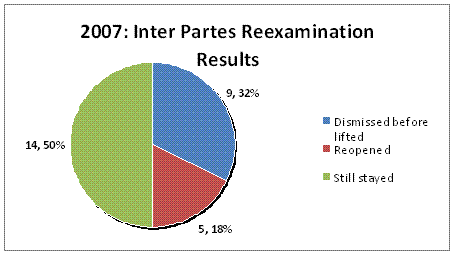
In those cases involving only inter partes patent reexamination, or both inter partes reexamination and ex parte reexamination, (below) only 18% of cases have been reopened, with a staggering 50% of cases still stayed. Adding together the 32% of cases that have been dismissed, indicates up to an 82% favorable result for such defendants.

stay3

A common complaint of Patentees facing a motion to stay pending inter partes patent reexamination is that granting of such a motion effectively suspends the case for years on end. In view of the 2007 results, it seems likely that argument will proliferate as defendants embrace inter partes filings in increasingly greater numbers.