
Cellectis Patent Surrendered by Operation of Inter Partes Reexamination Pendency

Last week, the litigation between Cellectis S.A. and Precision Biosciences Inc., (E.D. N.C) No: 5.08-CV-00119-H was stayed pending the outcome of inter partes patent reexamination proceedings involving the patents at issue in the litigation, namely, U.S. Patents 6,610,545 and 7,309,605. In the decision to stay the case, the same familiar factors were analyzed. Of particular interest is the court’s discussion of the “undue prejudice” factor.

In discussing the undue prejudice factor, the court noted that both of the patents at issue will expire in May of 2012. By pointing this out, the court surmised that should the case be stayed, any improper shifting of market share (due to infringement) would be transient at best in view of the relatively imminent patent expiration. Thus, the court found that the balance of equities favored staying the case. With regard to patent expiration, the court explained:

[I]t is uncertain whether the PTO’s reexamination will be completed before the patents expire and highly unlikely that any appeal of the PTO’s decision will be resolved prior to the expiration of the patents.

In pointing out this fact, the court unknowingly emphasized a sad reality for Cellectis. By amending the ‘605 Patent, Cellectis has effectively surrendered this patent by operation of USPTO pendency.

On November 17, 2009, the only independent claim of the ‘605 patent (claim 1) was amended to recite first  “chromosomal DNA” and “providing an isolated, viable cell . . .” On July 7, 2010, in response to an Action Closing Prosecution (ACP) of June 17, 2010, the independent claim was again amended to recite a further step of “repairing a double stranded break…” new claims 19-21 were also added in July. These features and new claims have been argued as distinguishing with respect to the submitted art of the inter partes patent reexamination. (In the ‘545 Patent, one of the independent claims, claim 7 was amended)

With appeal briefing, and BPAI processing still to come it is a practical certainty that there will not be a BPAI decision in this case prior to expiration of the ‘605 and ‘545 patents in the Spring of 2012. Importantly, upon expiration, any pending claim amendments are considered withdrawn (37 CFR 1.530 (j)) since such claim changes cannot be added by reexamination certificate thereafter. Thus, at the time of expiration, amended claims revert to unamended form, and any newly added claims simply go away…..seemingly, along with the ‘605 Patent.

Even assuming the BPAI somehow sided with Cellectis prior to expiration, the certain CAFC appeal by the third party would doom any opportunity to publish a reexamination certificate in time to actually issue the amended claims. (this calculation does not even account for the three month delay from the Notice of Intent to Issue a Reexamination Certificate (NIRC) to physical printing of the certificate).

At the time of expiration, a patent is construed more narrowly, yet one would assume the briefing will be based upon the amended claims.

Certainly, the USPTO has taken steps to speed up the processing of inter partes reexamination. Still, as this case demonstrates, there is a great deal of work still to be done. In the most recent BPAI data from the inter partes reexamination dashboard, the average BPAI pendency is shown as less than 10 months from the time of initial appeal docketing (shown in green as opposed yellow (bad) or red (really bad)). Disappointingly, the same 10 month metric is used with respect to run-of-the-mill, patent application appeals, yet patent reexaminations are supposed to be accorded special dispatch? (application BPAI pendency for July here). As pointed out by others in emails to me last week, including Hal Wegner and Paul Morgan, a 10-month benchmark is not at all encouraging.

flailing-swimmer-300x220The seemingly never ending Microsoft v. i4i dispute continued on to the doorstep of the Supreme Court last week. In 2009, Microsoft was found to have infringed i4i’s 5,787,449 patent, which allegedly claims certain XML translation features of Microsoft Word. An appeal to the CAFC earlier this year was unsuccessful. On August 27th, Microsoft filed a petition for certiorari questioning the lower court’s use of the clear and convincing standard relative to art not before the USPTO during prosecution of the original patent application.

Along the way, Microsoft sought ex parte reexamination of the ‘449 Patent (90/010,347), largely as an afterthought to hedge against a willfulness finding. Not surprisingly, since the request ignored definitions of certain claim terms of the ‘449 Patent specification, the reexamination attempt was unsuccessful and all claims exited reexamination in July of this year. With the trail now over, and appeal options exhausted (save the last ditch appeal to the Supreme Court), it would seem that at least the patent reexamination chapter of this saga was complete.

Yet, as reported by IPWatchdog yesterday, Microsoft has filed a second request for ex parte reexamination of the ‘449 patent (90/011,198) just last Tuesday. So, what exactly is Microsoft hoping to accomplish?  Continue Reading Microsoft Files Another Patent Reexamination Request Against i4i

copycatGEOSPAN Corporation filed a lawsuit in March 2008 in the United States District Court for the District of Minnesota, alleging that Pictometry infringed  GEOSPAN’s U.S. Patent No. 5,633,946.

In a separate action on November 11, 2008, GEOSPAN requested the U.S Patent Office to reexamine Pictometry’s U.S. Patent Number 7,424,133, entitled “Method and Apparatus for Capturing, Geolocating and Measuring Oblique Images.” This action is a procedure used by the U.S. Patent Office to allow the claims in existing patents to be contested (Ref. No. 95/001,110)

In its request, GEOSPAN set forth substantial new questions of patentability based upon  a September 5, 2002 printed publication by David Rattigan, a reported for a Boston newspaper. The USPTO ordered inter partes reexamination of the ‘133 Patent, and subsequently issued a Non-Final Office Action on February 2, 2009 rejecting claims 17-24 on anticipation and obviousness grounds. Currently, the rejections are on appeal to the BPAI.

On May 25, 2010, the patent owner filed its brief. On the appeal, the Patent Owner is contesting  the USPTO’s conclusion that the submitted declaration evidence filed under 37 C.F.R. § 1.131 (swear behind) is insufficient as well as the conclusion that declaration evidence filed under 37 C.F.R. § 1.132 is insufficient to disqualify the Rattigan publication based upon attribution. (MPEP 716.10). Of particular interest is the dispute between the USPTO and the Patent Holder as to whether declaration evidence can be used to disqualify a prior art reference as “attributed” to the  inventors’ work where none of the inventors is an author of the printed publication used to reject the claims.  Continue Reading Reporter’s Description of Invention at Issue in Patent Reexamination

Expanded BPAI Panel Shoots Down Repackaged SNQSince In re Swanson, the standard for establishing a Substantial New Question of Patentability (SNQ) in a patent reexamination has been quite liberal. A requester need only establish that the submitted art be presented in a new light. Thus, previously considered prior art can be re-used, if applied to the claims in a slightly different manner than that of the original prosecution. Understandably, since Swanson, arguing that a rejection adopted by the Office in patent reexamination does not in fact present the previously considered art in a new light has been an uphill battle.Yesterday, the USPTO found a rare SNQ it didn’t like….and pigs were seen flying down Dulany Street.U.S. Patent 6,780,079 is the subject of litigation styled MuzzyProducts Corporation v. Primos Inc., U.S. District Court of Georgia 4:05cv182. This case was stayed in 2007 pending the outcome of the reexamination, 90/008,081. The ‘079 Patent relates to a devices used in hunting for attracting game (game calling).Original ProsecutionDuring the original examination of the ‘868 application which eventually issued as the ‘079 patent, the claims were rejected under 35 U.S.C. § 103(a) as obvious over prior art Patent No. 5,607,091 “Musacchia”. The Examiner stated that while Musacchia does not disclose a hunting device for producing sounds that has a unitary construction, “unitary construction of the hunting device would have been obvious to one of ordinary skill in the art, since this would aid in the portability and usage of the device.”In response, the inventor, Mr. John Musacchia Jr., (prior art invented by his father) filed a Declaration seeking to establish non-obviousness through long-felt need.After extensive prosecution, the original Examiner maintained the rejection of the claims over Musacchia stating that “Musacchia discloses the claimed invention except for the game call device constructed as one piece” and that “[i]t would have been obvious to one having ordinary skill in the art at the time the invention was made to form the game call device as one piece, since it has been held that forming in one piece an article which has formerly been formed in two pieces and put together involves only routine skill in the art. Howard v. Detroit Stove Works, 150 U.S. 164 (1893).”After further prosecution, the Applicant appealed to the Board. The original Board panel reversed the original Examiner’s rejection stating that there is no per se rule that “forming several pieces integrally as a one-piece structure would have been obvious . . . [,]” and “in this case, one must determine if it would have been obvious to one of ordinary skill in the art at the time the invention was made to make Musacchia’s separate call and platform as a one-piece structure.” Subsequently, the application was then allowed by the examiner.Request for ReexaminationIn the request for reexamination, the Requester argued that the Declaration filed during the prosecution of the ‘079 patent was only considered as to whether it demonstrated long-felt need, and not considered by either the original Examiner or the original Board panel as including admissions.The USPTO adopted this reasoning explaining the admissions to be statements made by the Patent Owner in his declaration and remarks that identify the long-unfelt need. Specifically, these remarks explain that a one piece design was considered desirable by those of skill in the art and would predictably result in preventing the loss of game calls, maintaining a true sound, and reducing the cost of the game call.In this regard, the Office stated that, when considered as admissions, the statements of the Declarationprovide evidence of obviousness, which was specifically pointed out as missing in the prior examination, and therefore, cast Musacchia ‘091 in a new light. The teachings of Musacchia ‘091 considered in conjunction with the admissions are a new question of patentability not previously considered. As such, the teachings of Musacchia ‘091, in conjunction with the admissions in the record, raise a substantial new question of patentability.Board DecisionThe Board remanded (decision here) the reexamination back to the Central Reexamination Unit for termination explaining that:While the CRU Examiner may be correct in asserting that the original Examiner and the previous Board panel considered the statements in the Declaration only in the context of long-felt need, these statements do not alter the purpose for which the CRU Examiner now relies on the Musacchia reference for finding the existence of a SNQ. In particular, the CRU Examiner does not apply the statements in the Declaration to gain any new understanding as to the teachings of the Musacchia reference, but rather, uses the statements merely to reach a different legal conclusion as to obviousness. While the CRU Examiner asserts that the statements in the Declaration casts Musacchia in a “new light,” the CRU Examiner’s position suggests that the CRU Examiner is viewing the Declaration, not the Musacchia reference, in a new light.PPG Comment : The Requester gets an “A” for effort.Essentially, this reexamination was pursued to leverage the perceived change in obviousness standards caused KSR International Co. v. Teleflex Inc (‘079 Patent issued pre-KSR). Ths request was submitted under the guise of declaration admissions in the hopes that applying KSR to the same art would yield different results. Of course, MPEP 2216 makes it very clear that KSR does not impact the SNQ analysis.**Fortunately for the patent owner, as of June 25, 2010, the Board may now properly review the examiner’s determination that a SNQ exists. Prior to June 25, 2010 the Patent Owner’s argument would have been rejected by the BPAI as a petitionable issue.

Since In re Swanson, the standard for establishing a Substantial New Question of Patentability (SNQ) in a patent reexamination has been quite liberal. A requester need only establish that the submitted art be presented in a new light. Thus, previously considered prior art can be re-used, if applied to the claims in a slightly different manner than that of the original prosecution. Understandably, since Swanson, arguing that a rejection adopted by the Office in patent reexamination does not in fact present the previously considered art in a new light has been an uphill battle.

Yesterday, the USPTO found a rare SNQ it didn’t like….and pigs were seen flying down Dulany Street.

U.S. Patent 6,780,079 is the subject of litigation styled MuzzyProducts Corporation v. Primos Inc., U.S. District Court of Georgia 4:05cv182. This case was stayed in 2007 pending the outcome of the reexamination, 90/008,081. The ‘079 Patent relates to a devices used in hunting for attracting game (game calling).

Original Prosecution

During the original examination of the ‘868 application which eventually issued as the ‘079 patent, the claims were rejected under 35 U.S.C. § 103(a) as obvious over prior art Patent No. 5,607,091 “Musacchia”. The Examiner stated that while Musacchia does not disclose a hunting device for producing sounds that has a unitary construction, “unitary construction of the hunting device would have been obvious to one of ordinary skill in the art, since this would aid in the portability and usage of the device.”

In response, the inventor, Mr. John Musacchia Jr., (prior art invented by his father) filed a Declaration seeking to establish non-obviousness through long-felt need.

After extensive prosecution, the original Examiner maintained the rejection of the claims over Musacchia stating that “Musacchia discloses the claimed invention except for the game call device constructed as one piece” and that “[i]t would have been obvious to one having ordinary skill in the art at the time the invention was made to form the game call device as one piece, since it has been held that forming in one piece an article which has formerly been formed in two pieces and put together involves only routine skill in the art. Howard v. Detroit Stove Works, 150 U.S. 164 (1893).”

After further prosecution, the Applicant appealed to the Board. The original Board panel reversed the original Examiner’s rejection stating that there is no per se rule that “forming several pieces integrally as a one-piece structure would have been obvious . . . [,]” and “in this case, one must determine if it would have been obvious to one of ordinary skill in the art at the time the invention was made to make Musacchia’s separate call and platform as a one-piece structure.” Subsequently, the application was then allowed by the examiner.

Request for Reexamination

In the request for reexamination, the Requester argued that the Declaration filed during the prosecution of the ‘079 patent was only considered as to whether it demonstrated long-felt need, and not considered by either the original Examiner or the original Board panel as including admissions.

The USPTO adopted this reasoning explaining the admissions to be statements made by the Patent Owner in his declaration and remarks that identify the long-unfelt need. Specifically, these remarks explain that a one piece design was considered desirable by those of skill in the art and would predictably result in preventing the loss of game calls, maintaining a true sound, and reducing the cost of the game call.

In this regard, the Office stated that, when considered as admissions, the statements of the Declaration

provide evidence of obviousness, which was specifically pointed out as missing in the prior examination, and therefore, cast Musacchia ‘091 in a new light. The teachings of Musacchia ‘091 considered in conjunction with the admissions are a new question of patentability not previously considered. As such, the teachings of Musacchia ‘091, in conjunction with the admissions in the record, raise a substantial new question of patentability.

Board Decision

The Board remanded (decision here) the reexamination back to the Central Reexamination Unit for termination explaining that:

While the CRU Examiner may be correct in asserting that the original Examiner and the previous Board panel considered the statements in the Declaration only in the context of long-felt need, these statements do not alter the purpose for which the CRU Examiner now relies on the Musacchia reference for finding the existence of a SNQ. In particular, the CRU Examiner does not apply the statements in the Declaration to gain any new understanding as to the teachings of the Musacchia reference, but rather, uses the statements merely to reach a different legal conclusion as to obviousness. While the CRU Examiner asserts that the statements in the Declaration casts Musacchia in a “new light,” the CRU Examiner’s position suggests that the CRU Examiner is viewing the Declaration, not the Musacchia reference, in a new light.

PPG Comment : The Requester gets an “A” for effort.

Essentially, this reexamination was pursued to leverage the perceived change in obviousness standards caused KSR International Co. v. Teleflex Inc (‘079 Patent issued pre-KSR). Ths request was submitted under the guise of declaration admissions in the hopes that applying KSR to the same art would yield different results. Of course, MPEP 2216 makes it very clear that KSR does not impact the SNQ analysis.

**Fortunately for the patent owner, as of June 25, 2010, the Board may now properly review the examiner’s determination that a SNQ exists. Prior to June 25, 2010 the Patent Owner’s argument would have been rejected by the BPAI as a petitionable issue.

MIB coverass=”alignleft size-full wp-image-3515″ title=”MIB cover” src=”https://www.patentspostgrant.com/wp-content/uploads/2010/08/MIB-cover.bmp” alt=”MIB cover” />The recently published Volume 2, Issue 2 of the journal Medical Innovation & Business focused entirely on patent reform’s potential impact on medical innovation.  Special guest editors Renee Kaswan, David Boundy, and Ron Katznelson express particular concern that patent reform will weaken the investment incentive for innovations with high development costs and low production costs, notably including medical innovations.  Numerous articles in this issue discuss the effects that proposed post-grant review might have on the value of smaller companies’ patents and therefore on the incentives to invest in such companies. The articles in this patent reform issue of Medical Innovation & Business that are relevant to post-grant procedures for assessing validity fall roughly into three categories based on three different perspectives: venture capitalists’ perspective, the perspective of attorneys in private practice, and judicial perspective. Across these categories, post-grant discussions repeatedly highlight several sources of uncertainty that may apply to small companies relying on their intellectual property investments. We provide the following review of the articles in this issue that pertain to post-grant review. Continue Reading Potential Impact of Patent Reform on Medical Innovation

yourenothelpingIf you are one of the foolish people out there under the impression that the U.S. banking and real estate crash has led to the current economic state, heightened unemployment, etc, you would be wrong. Turns out, the 18 month publication of patent applications, and 35 USC  § 102(e) have ruined the U.S economy….who knew?

On July 29, 2010 H.R. 5980 was introduced by Congressman Frank Wolf (R-VA) as the “Bring Jobs Back to America: Strategic Manufacturing & Job Repatriation Act.” How can anyone vote against that noble cause!?

Unfortunately, once past the flowery title, the substance of the bill, at least with respect to the proposed patent law changes is simply a collection of oddball provisions that would neither achieve any meaningful reform nor job repatriation. Continue Reading HR 5980 Distracts From Patent Reform Efforts

Did the Patent Holder Miss the Boat on Claim Interpretation?On Tuesday, the BPAI seemingly ended the 10 year saga of Ex Parte Gary E. Rhine affirming the examiner’s rejection of expired U.S. Patent 4,910,652.[1] The reexamination was  initiated in April 2000 on behalf of Casio Computer by the now long defunct law firm of Pennie & Edmonds. At issue in the appeal was the patentability of a combination wristwatch/flashlight. In 2002, the Patent Owner amended claim 1 to require a fixed time delay, arguing that the prior art demonstrated an adjustable time delay. However, the reexamination lagged on for years, and prior to appeal, in 2007, the patent expired. On appeal, the USPTO explained that the amendment was effectively withdrawn upon patent expiration in 2007.In a scathing supplemental brief (here) the Patent Owner pointed out that the reexamination had been pending some 10 years, including some unexplained year long gaps in prosecution, bounced appeal briefs, etc. The Patent Owner argued that in light of this delay, it was “outrageous” that the USPTO would withdraw the amendment.While a 10 year pendency is extreme to say the least, this reexamination was filed in a time before the creation of the Central Reexamination Unit (CRU). This case is one of the few remaining with the general examining corps. Likewise, ex parte reexamination appeal rules have been changed to avoid the rejection of appeal briefs late in the game. While not much comfort to Mr. Rhine, fortunately, the patent reexamination landscape has changed significantly over the years.Nevertheless, of perhaps greater interest is why the Patent Owner would amend the claims in the first place since the winning argument was right under his nose.At issue in the appeal was a single independent claim, claim 1 below (as amended): 1. (As Amended) A time keeping and displaying wrist mountable watch having a flashlight mounted in the case thereof, said flashlight comprising:a power supply for supplying electrical power to said flashlight, said power supply electrically connected to at least one light source, andtime delay means for automatically extinguishing said light source after a fixed time delay following the energization of said light source by the electrical deenergization of said light source.  The Office identified the time delay means as being satisfied by the Mallory reference (Fig. 1 below)PPG Comment: Rather than arguing that the “time delay means” of the claim was required to be interpreted under 35 USC § 112 6th paragraph (i.e., means plus function) and that the circuit structure of the specification was nowhere near an equivalent structure to the mechanical spring/bellows arrangement of Mallory, the Patent Holder instead argued the reference was non-analogous art, and could not be bodily incorporated into a watch. Giving the Patent Holder the benefit of the doubt, perhaps the aversion to 112 6th was litigation inspired. For example, the solenoid/capacitive based circuitry of the patent specification, although described as exemplary, could limit infringement options.While the BPAI cannot be blamed for not making the Patent Holder’ s argument for him, I am left wondering whether a statutorily mandated claim construction can be ignored regardless of the implied “waiver” of such arguments in the brief? As pointed out repeatedly on this blog, the USPTO could save Patent Holders a lot of grief, and conserve Office resources by requiring third party requesters to properly address means-plus-function claims, upfront, in their requests for reexamination.[1] Patent Owner sued Casio Computer in 1998 on this patent Rhine v. Casio Inc., Inc., No. 3:96CV7524 (N.D. Ohio May 12, 1998). After a remand from the CAFC, the case was dismissed in 2005 without prejudice in light of the reexaminati

On Tuesday, the BPAI seemingly ended the 10 year saga of Ex Parte Gary E. Rhine affirming the examiner’s rejection of expired U.S. Patent 4,910,652.[1] The reexamination was  initiated in April 2000 on behalf of Casio Computer by the now long defunct law firm of Pennie & Edmonds. At issue in the appeal was the patentability of a combination wristwatch/flashlight. In 2002, the Patent Owner amended claim 1 to require a fixed time delay, arguing that the prior art demonstrated an adjustable time delay. However, the reexamination lagged on for years, and prior to appeal, in 2007, the patent expired. On appeal, the USPTO explained that the amendment was effectively withdrawn upon patent expiration in 2007.

In a scathing supplemental brief (here) the Patent Owner pointed out that the reexamination had been pending some 10 years, including some unexplained year long gaps in prosecution, bounced appeal briefs, etc. The Patent Owner argued that in light of this delay, it was “outrageous” that the USPTO would withdraw the amendment.

While a 10 year pendency is extreme to say the least, this reexamination was filed in a time before the creation of the Central Reexamination Unit (CRU). This case is one of the few remaining with the general examining corps. Likewise, ex parte reexamination appeal rules have been changed to avoid the rejection of appeal briefs late in the game. While not much comfort to Mr. Rhine, fortunately, the patent reexamination landscape has changed significantly over the years.

Nevertheless, of perhaps greater interest is why the Patent Owner would amend the claims in the first place since the winning argument was right under his nose.

At issue in the appeal was a single independent claim, claim 1 below (as amended): 

1. (As Amended) A time keeping and displaying wrist mountable watch having a flashlight mounted in the case thereof, said flashlight comprising:

a power supply for supplying electrical power to said flashlight, said power supply electrically connected to at least one light source, and

time delay means for automatically extinguishing said light source after a fixed time delay following the energization of said light source by the electrical deenergization of said light source.  

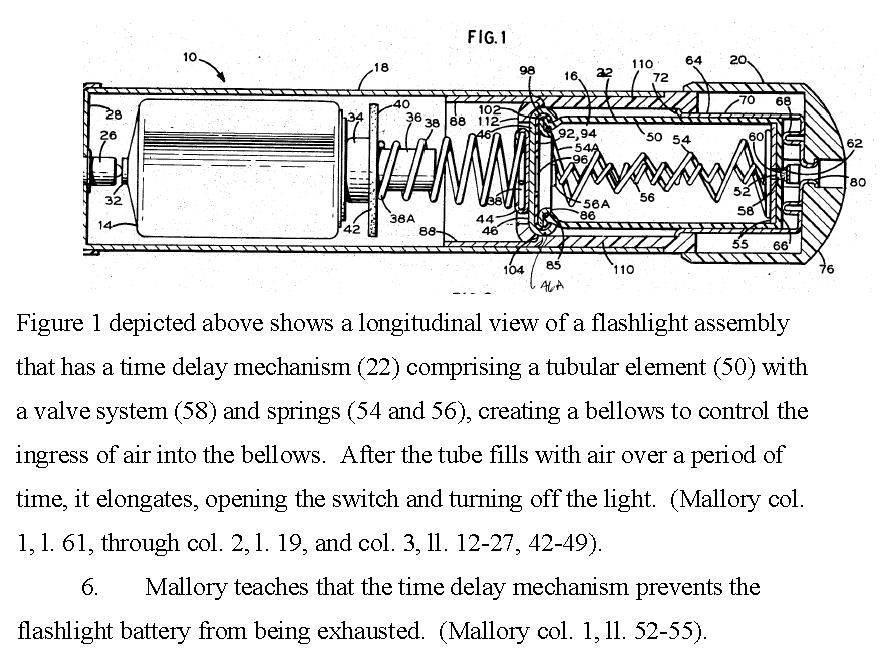
The Office identified the time delay means as being satisfied by the Mallory reference (Fig. 1 below)

Fig1

PPG Comment: Rather than arguing that the “time delay means” of the claim was required to be interpreted under 35 USC § 112 6th paragraph (i.e., means plus function) and that the circuit structure of the specification was nowhere near an equivalent structure to the mechanical spring/bellows arrangement of Mallory, the Patent Holder instead argued the reference was non-analogous art, and could not be bodily incorporated into a watch. Giving the Patent Holder the benefit of the doubt, perhaps the aversion to 112 6th was litigation inspired. For example, the solenoid/capacitive based circuitry of the patent specification, although described as exemplary, could limit infringement options.

While the BPAI cannot be blamed for not making the Patent Holder’ s argument for him, I am left wondering whether a statutorily mandated claim construction can be ignored regardless of the implied “waiver” of such arguments in the brief? As pointed out repeatedly on this blog, the USPTO could save Patent Holders a lot of grief, and conserve Office resources by requiring third party requesters to properly address means-plus-function claims, upfront, in their requests for reexamination.


[1] Patent Owner sued Casio Computer in 1998 on this patent Rhine v. Casio Inc., Inc., No. 3:96CV7524 (N.D. Ohio May 12, 1998). After a remand from the CAFC, the case was dismissed in 2005 without prejudice in light of the reexamination.

blindersOn August 20, 2010, a motion to stay the litigation between 3M Innovative Properties Co., et al. and Envisionware, Inc. (0-09-cv-01594) (NDM) pending the outcome of a parallel patent reexamination was denied. At issue in the litigation are three of 3M’s patents relating to RFID technology, namely 6,232,870, 6,486,780 and 6,857,568. Envisionware requested inter partes reexamination of the ‘780 and ‘568 Patents. Curiously, since the third patent, the ‘870 Patent does not qualify for inter partes reexamination, reexamination of this patent was not sought at all. A non-final office action rejecting  the ’568 Patent claims was issued by the USPTO, the ‘780 Reexamination has yet to begin. On August 2, 2010, Envisionware filed the motion to stay the litigation.

The court denied the motion to stay the litigation citing familiar factors, noting that (1) the stay would prejudice the plaintiff, (2) the stay would not likely simplify the issues in litigation and facilitate trial, and (3) discovery will soon be complete. Yet, clearly, of more interest to the court was why Envisionware chose to ignore the ‘870 Patent altogether. Continue Reading Rubbing the Court the Wrong Way in Seeking a Stay Pending Patent Reexamination

Can an Ongoing Patent Reexamination be Stopped?With most patent reexaminations now being conducted concurrent to a district court or ITC proceeding, a common question of such plaintiffs is “what becomes of the patent reexamination once the litigation settles?”In the case of ex parte patent reexamination, the answer is simple, the reexamination continues unaffected. On the other hand, if the pending reexamination is an inter partes patent reexamination, the answer will depend on the nature of the settlement.In other words, inter partes patent reexamination is subject to statutory estoppel provisions not applicable to ex parte patent reexamination. Depending upon the manner in which the case settles, and whether or not the case is before the ITC, a carefully worded consent judgment can be used to trigger 35 USC § 317 (b), effectively forcing the USPTO to vacate the proceeding by operation of estoppel.35 USC § 317 (b) provides:(b) FINAL DECISION.- Once a final decision has been entered against a party in a civil action arising in whole or in part under section 1338 of title 28, that the party has not sustained its burden of proving the invalidity of any patent claim in suit or if a final decision in an inter partes reexamination proceeding instituted by a third-party requester is favorable to the patentability of any original or proposed amended or new claim of the patent, then neither that party nor its privies may thereafter request an inter partes reexamination of any such patent claim on the basis of issues which that party or its privies raised or could have raised in such civil action or inter partes reexamination proceeding, and an inter partes reexamination requested by that party or its privies on the basis of such issues may not thereafter be maintained by the Office, notwithstanding any other provision of this chapter. This subsection does not prevent the assertion of invalidity based on newly discovered prior art unavailable to the third-party requester and the Patent and Trademark Office at the time of the inter partes reexamination proceedings. (emphasis added)It is important to note that the estoppel provisions of inter partes patent reexamination do not apply to ITC proceedings, see our earlier discussion of this issue.With respect to district court proceedings, where parties agree to settle, and the defendant is also willing to accede to a consent judgment stating that they have failed to prove invalidity, such may serve as a final judgment. (once the 30 day time to appeal the consent order has passed). In considering the language of the consent order, the USPTO will look to whether or not the claims of the ongoing inter partes reexamination are the same as that at issue in the litigation. For claims of the ongoing reexamination that are not subject to the consent judgment, the reexamination would continue as estoppel would not attach for these claims. (likewise for any newly added claims) Attached is a 2009 petition decision detailing a vacatur of an inter partes patent reexamination. (here)In practice, defendants rarely agree to such a consent order since such a public humliation is not all desirable. (e.g., especially if the defendant is frequently the target of patent trolls). Likewise, as noted in the petition decision linked above, although the reexamination is vacated by the estoppel as to the particular setttling defendant, the unfinished business of the reexamination may be easily “re-started” by another competitor. Still, in settling patent disputes concurrent with inter partes patent reexamination, plaintiffs may be amenable to such a consent judgement ….for the right pri

With most patent reexaminations now being conducted concurrent to a district court or ITC proceeding, a common question of such plaintiffs is “what becomes of the patent reexamination once the litigation settles?”

In the case of ex parte patent reexamination, the answer is simple, the reexamination continues unaffected. On the other hand, if the pending reexamination is an inter partes patent reexamination, the answer will depend on the nature of the settlement.

In other words, inter partes patent reexamination is subject to statutory estoppel provisions not applicable to ex parte patent reexamination. Depending upon the manner in which the case settles, and whether or not the case is before the ITC, a carefully worded consent judgment can be used to trigger 35 USC § 317 (b), effectively forcing the USPTO to vacate the proceeding by operation of estoppel.

35 USC § 317 (b) provides:

(b) FINAL DECISION.- Once a final decision has been entered against a party in a civil action arising in whole or in part under section 1338 of title 28, that the party has not sustained its burden of proving the invalidity of any patent claim in suit or if a final decision in an inter partes reexamination proceeding instituted by a third-party requester is favorable to the patentability of any original or proposed amended or new claim of the patent, then neither that party nor its privies may thereafter request an inter partes reexamination of any such patent claim on the basis of issues which that party or its privies raised or could have raised in such civil action or inter partes reexamination proceeding, and an inter partes reexamination requested by that party or its privies on the basis of such issues may not thereafter be maintained by the Office, notwithstanding any other provision of this chapter. This subsection does not prevent the assertion of invalidity based on newly discovered prior art unavailable to the third-party requester and the Patent and Trademark Office at the time of the inter partes reexamination proceedings. (emphasis added)

It is important to note that the estoppel provisions of inter partes patent reexamination do not apply to ITC proceedings, see our earlier discussion of this issue.

With respect to district court proceedings, where parties agree to settle, and the defendant is also willing to accede to a consent judgment stating that they have failed to prove invalidity, such may serve as a final judgment. (once the 30 day time to appeal the consent order has passed). In considering the language of the consent order, the USPTO will look to whether or not the claims of the ongoing inter partes reexamination are the same as that at issue in the litigation. For claims of the ongoing reexamination that are not subject to the consent judgment, the reexamination would continue as estoppel would not attach for these claims. (likewise for any newly added claims) Attached is a 2009 petition decision detailing a vacatur of an inter partes patent reexamination. (here)

In practice, defendants rarely agree to such a consent order since such a public humliation is not all desirable. (e.g., especially if the defendant is frequently the target of patent trolls). Likewise, as noted in the petition decision linked above, although the reexamination is vacated by the estoppel as to the particular setttling defendant, the unfinished business of the reexamination may be easily “re-started” by another competitor. Still, in settling patent disputes concurrent with inter partes patent reexamination, plaintiffs may be amenable to such a consent judgement ….for the right price.

Estoppel of 35 USC § 317(b) Applies Only to Inter Partes Patent ReexaminationOne of the risks often associated with ex parte patent reexamination is that an outcome favorable to a patent holder is considered to “gold plate” a patent that is later asserted against the requester in district court, especially with respect to the same or similar art. This notion was tested recently in Crestron Electronics Inc. v. RGB Systems Inc., CV 09-8402 (CDCA).Crestron’s U.S. Design Patent D569,863 is asserted against RGB in the California District Court. RGB had earlier sought ex parte reexamination of the same patent based upon the same prior art now applied in the district court proceeding. Not surprisingly, Crestron noted that the reexamination attempt based on the same art now before the district court had failed to invalidate the patent. In other words, without any presumption of validity, and the ability to invalidate the patent by a mere preponderance of the evidence, RGB failed. Thus, Crestron argued that the reexamination results should preclude an invalidity defense on the same art. The court decided that not only can RGB argue the same invalidity positions over again, but that the court need not even show deference to the reexamination results.More specifically, the court sided with RGB’s argument that:…a district court must make its own validity determination and may not rubberstamp the PTO’s reexamination decision. E.g. Quad Environmental Tech. Corp. v. Union Sanitary Dist., 946 F.2d 870, 876 (Fed. Cir. 1991) (“The courts are the final arbiter of patent validity and, although courts may take cognizance of, and benefit from, the proceedings before the patent examiner, the question is ultimately for the courts to decide, without deference to the rulings of the patent examiner.”).PPG Comment: Part of the problem with reading Quad Environmental so extensively is that the facts are quite distinguishable. While Quad also dealt with the issue of an earlier concluded reexamination on some of the same art, the key invalidity issue before the Quad Court related to public use evidence not considered in the concluded reexamination. Thus, it is quite clear why the Quad Court concluded that the earlier reexamination was not to be accorded deference, and why the Court must do their own validity analysis in most cases. However, here where the art and issues are identical, and RGB failed to prove invalidity under much more liberal USPTO standards, some deference seems appropriate. To be sure, courts often cite to the potential results of patent reexamination to justify staying a case, yet when given the opportunity to actually conserve judicial resources based on such results………Of course, inter partes reexamination remedies this dilemma by operation of statutory estoppel (317 (b

One of the risks often associated with ex parte patent reexamination is that an outcome favorable to a patent holder is considered to “gold plate” a patent that is later asserted against the requester in district court, especially with respect to the same or similar art. This notion was tested recently in Crestron Electronics Inc. v. RGB Systems Inc., CV 09-8402 (CDCA).

Crestron’s U.S. Design Patent D569,863 is asserted against RGB in the California District Court. RGB had earlier sought ex parte reexamination of the same patent based upon the same prior art now applied in the district court proceeding. Not surprisingly, Crestron noted that the reexamination attempt based on the same art now before the district court had failed to invalidate the patent. In other words, without any presumption of validity, and the ability to invalidate the patent by a mere preponderance of the evidence, RGB failed. Thus, Crestron argued that the reexamination results should preclude an invalidity defense on the same art. The court decided that not only can RGB argue the same invalidity positions over again, but that the court need not even show deference to the reexamination results. More specifically, the court sided with RGB’s argument that:

…a district court must make its own validity determination and may not rubberstamp the PTO’s reexamination decision. E.g. Quad Environmental Tech. Corp. v. Union Sanitary Dist., 946 F.2d 870, 876 (Fed. Cir. 1991) (“The courts are the final arbiter of patent validity and, although courts may take cognizance of, and benefit from, the proceedings before the patent examiner, the question is ultimately for the courts to decide, without deference to the rulings of the patent examiner.”).

PPG Comment: Part of the problem with reading Quad Environmental so extensively is that the facts are quite distinguishable. While Quad also dealt with the issue of an earlier concluded reexamination on some of the same art, the key invalidity issue before the Quad Court related to public use evidence not considered in the concluded reexamination. Thus, it is quite clear why the Quad Court concluded that the earlier reexamination was not to be accorded deference, and why the Court must do their own validity analysis in most cases. However, here where the art and issues are identical, and RGB failed to prove invalidity under much more liberal USPTO standards, some deference seems appropriate. To be sure, courts often cite to the potential results of patent reexamination to justify staying a case, yet when given the opportunity to actually conserve judicial resources based on such results………

Of course, inter partes reexamination remedies this dilemma by operation of statutory estoppel (317 (b)).