Evidence of Petitioner Control Critical for PTAB Privity Finding

Under 35 U.S.C. § 315(b) a petitioner, real party-in-interest, or privy of the petitioner must seek Inter Partes Review (IPR) within 12 months of service of a complaint for patent infringement. In an attempt to dodge some IPR filings as time barred, patentees are urging the USPTO Patent Trial & Appeal Board (PTAB) to adopt an expansive interpretation of privy. That is, since parties are often time embroiled in patent suits at different times, expanding the 12 month window to encompass the first filed suit could insulate many patentees from dreaded IPR challenges.

As detailed previously, in Atlanta Gas Light Company v. Bennett Regulator Guards Inc., (IPR2013-00453, Paper 31, January 22, 2014), the PTAB agreed that the existence of an indemnification agreement was probative of the opportunity for control by a supplier of a customer petitioner. However, the PTAB is seeking more than the mere existence of an agreement, but instead, hard evidence of control.

More recently in Broadcom Corp. v. Telefonaktiebolaget LM Ericsson (IPR2013-00601, Paper 23, January 24, 2014) the patentee attempted to present enough circumstantial evidence of privity from public documents to justify additional discovery, the PTAB declined the request for additional discovery, explaining:

Contrary to [patentees] assertion that “[t]he weight of authority strongly supports that an indemnity agreement . . . establish[es] privity,” Mot. 6, Bros. Inc, TRW, Dentsply and other cases noted supra illustrate that more is required. Control of the litigation, or some sort of representation, constitutes a “crucial” factor. . .

The totality of this evidence fails to amount to more than a “mere possibility” that [petitioner] controlled, or could have controlled, the Texas Litigation. Paying for trial expenses pursuant to indemnity normally does not establish privity or control. Therefore, the sought-after indemnity agreements, and the requested discovery items seeking evidence of payment pursuant to indemnity or other agreements, fail to amount to more than a “mere allegation that something useful will be found” to establish privity.

As made clear in this decision, establishment of privity will not be possible absent a smoking gun document (the decision goes through a pile of circumstantial evidence denied as persuasive, worth a read). Since such a smoking gun document will almost never be public, and the PTAB will not grant discovery for uncovering it, patentees would be wise to seek this discovery via the district court at the earliest possible time.

For a co-pending litigation that is facing a motion to stay, despite the long odds, patentees would be prudent to raise the issue of privity in their preliminary response and on teleconferences with the Board (i.e., court reporter) for the purpose of creating a record of the dispute. Thereafter, perhaps the judge on the district court side will permit limited discovery on the issue even if the case is stayed as to the merits, or the record may prove valuable in demonstrating gamesmanship on the part of the patent challengers to avoid estoppel. (a factor considered in a stay analysis). Indeed, the district court’s concept of privity may be quite different than that of the PTAB.

PTAB Rejects Early Motions to Exclude as Improper

The Patent Trial & Appeal Board (PTAB) has begun issuing a steady stream of final written decisions in Inter Partes Review (IPR) and Covered Business Method (CBM) proceedings. In these initial decisions, the Board is denying a significant number of improperly filed motions to exclude from both petitioners and patentees alike. Specifically, the Board is urging that a proper motion to exclude is not filed to: (1) challenge the sufficiency of the opposing parties evidence; (2) serve as a sur-reply; or (3) attack evidence raised in petitioner filings as being “new.” Instead, a proper motion to exclude must be keyed to an earlier made evidentiary objection.

While the PTAB is diligently educating the public on the proper motion practice in the initial wave of decisions, failure to heed the guidance in these initial decisions may result in attorney sanctions down the line.

The PTAB analyzed a series of such motions in the final written decision for Liberty Mutual Insurance Co. v. Progressive Casualty Insurance Co. (CBM2012-00002, Paper 66, January 23, 2014). In Progressive, the PTAB explained:

A motion to exclude must explain why the evidence is not admissible (e.g., relevance or hearsay), but may not be used to challenge the sufficiency of the evidence to prove a particular fact. Office Patent Trial Practice Guide, 77 Fed. Reg. 48765, 48767 (Aug. 14, 2012). A motion to exclude evidence also must:

(a) Identify where in the record the objection originally was made;
(b) Identify where in the record the evidence sought to be excluded was relied upon by an opponent;
(c) Address objections to exhibits in numerical order; and
(d) Explain each objection.

Motions to exclude do not require Board authorization prior to filing, thus, rendering them ripe for abuse. Many such motions filed in Progressive were dismissed as improper. The Board explained repeatedly that such motions are “not an opportunity to file a sur-reply, and.  . .  not a mechanism to argue that a reply contains new arguments or relies on evidence necessary to make out a prima facie case.”  With respect to “new arguments” (a common gripe of patentees) the PTAB explained that it would be unreasonable to prohibit rebuttal testimony from petitioners on content not originally referenced in their petition (i.e., issues raised by the patentee as distinguishing).

As to closer calls, the Board emphasized an overall policy of inclusion, explaining:

There is a strong public policy for making all information filed in a non-jury, quasi-judicial administrative proceeding available to the public, especially in an inter partes review which determines the patentability of claim in an issued patent. It is within the Board’s discretion to assign the appropriate weight to be accorded to evidence. . . . We also agree with [patentee] that “the Board, sitting as a non-jury tribunal with administrative expertise, is well-positioned to determine and assign appropriate weight to the evidence presented in this trial, without resorting to formal exclusion that might later be held reversible error.” Opp. 1 (citing e.g., S.E.C. v. Guenthner, 395 F. Supp. 2d 835, 842 n.3 (D. Neb. 2005)).

In other words, unless you have a very clear-cut evidentiary deficiency to point out to the Board, you may be risking sanctions in the months ahead by filing something a bit more…. “creative.”

(Note: Motions to exclude will be far more appropriate in CBM and PGR proceedings that include fact witnesses, (i.e., evidence pertaining to public use/on sale bars and the like.)

USPTO Proposes Attributable Owner Requirements

Last week, the USPTO released a Notice of Proposed Rulemaking (NPRM) entitled Changes to Require Identification of Attributable Owner. The proposals would heap significant new administrative requirements on patent owners in the name of thwarting abusive patent suits. The agency explains the new reporting requirements will, in part, reduce risk of abusive patent litigation by helping the public defend itself against such abusive assertions by providing more information about all the parties that have an interest in patents or patent applications.

The proposal is unlikely to cause any kind of meaningful relief for companies targeted by patent trolls. Unfortunately, this effort is being driven from the White House. The PTO is fully expecting the firestorm that is coming to push back on this misguided mandate….unleash the fury.

Indemnification Obligation May Trigger IPR Clock

Indemnification from a claim of patent infringement is a common warranty in contractual agreements for the exchange of technological goods. In the event of an infringement claim against the contracted goods/services, a demand for indemnity triggers a duty of the supplier to defend against the claim in some manner, typically funding the defense, or taking over responsibility for the defense effort. As I discussed previously, indemnification clauses require special attention after the America Invents Act (AIA).

Recently, in Atlanta Gas Light Company v. Bennett Regulator Guards Inc., (IPR2013-00453, Paper 31, January 22, 2014) the Patent Trial & Appeal Board (PTAB) analyzed the interplay of an indemnification obligation as it relates to 35 U.S.C. § 312(a) and the 12 month window of 35 U.S.C. § 315(b). That is, does the existence of a contract/indemnification clause create privity between the contracting party under the IPR statutes, or render an indemnitor a real-party-in-interest with respect to the indemnified party?

At the heart of this case (the most confusing fact pattern in the history of the world, greatly simplified here for your casual reading pleasure), was that the lawsuit filed by the patentee was served on Indemnitor X on July 11, 2012, and the petitioner (indemnified party) was served a week later on July 18th. These dates were important as the IPR petition was filed on the one year anniversary of the 18th (i.e., not the 11th). So, if the patentee were successful in arguing that Indemnitor was a “real-party-in-interest”, or “privy” to the IPR petitioner, the filing would have been 7 days outside of the 12 month window of 315(b).

First, the patentee argued that the petitioner and Indemnitor were real-parties-in-interest (RPIs) since Indemnitor was contractually obligated to indemnify the petitioner, and the petitioner was contractually obligated to cooperate in the defense. Therefore, the patentee reasoned that Indemnitor was likely controlling the petitioner — and must be named as an RPI in the petition under 35 U.S.C. § 312(a). However, this argument was shot down after additional briefing, and a declaration from the petitioner that no such control was provided. (to add to the intrigue, petitioner was dismissed from the lawsuit prior to filing of the IPR making them seem all the more like a “straw-man” of the Indemnitor in the eyes of the patentee)

Second, and perhaps of more interest going forward was the argument centering on the impact of an indemnity obligation on 35 U.S.C. § 315(b). Here, the patentee alleged that the existence of the indemnification clause created “privity” between Indemnitor and the petitioner. The PTAB acknowledged that “privity” is a more expansive concept than RPI. However, the PTAB found that privity was not created until the indemnification obligation was triggered by the complaint filing (i.e., July 18th), explaining:

. . .Patent Owner’s privity theory relies fundamentally on [Indemnitor] having the right to control Petitioner’s involvement in this proceeding—a right that, at best, arises from Petitioner having been served with the complaint in the district court proceeding. Service upon [Indemnitor], prior to service upon Petitioner, creates no clear obligation or opportunity for control of Petitioner by [Indemnitor] in this proceeding. To the extent that such obligation or opportunity for control arose when Petitioner was served on July 18, 2012, Petitioner’s filing on July 18, 2013, is timely.

Clearly, the Board did not need to reach the question of whether or not privity actually existed as a result of the claim for indemnification. Instead, the Board surmised that even if it did exist at the time of the claim, the creation of privity on July 18th was not outside of the 12 month window. Still, one might be left with the impression that a presumption of privity could be created upon trigger of an indemnity obligation.

Post Grant CLE Tomorrow at USPTO

Just a reminder that the 9th Annual Advanced Patent Law Institute is underway at the United States Patent & Trademark Office (USPTO. This two day program offers several post grant patent discussions tomorrow, including:  AIA Practice Tips Before the Patent Trial and Appeal Board; Post-Grant Proceedings, Strategies and Practice; and Ex Parte Reexam in View of Fresenius – A Hail Mary Pass Which Should Be in Every Playbook.

Statistics Demonstrate Staggering Demand for PTAB Patent Challenge Proceedings

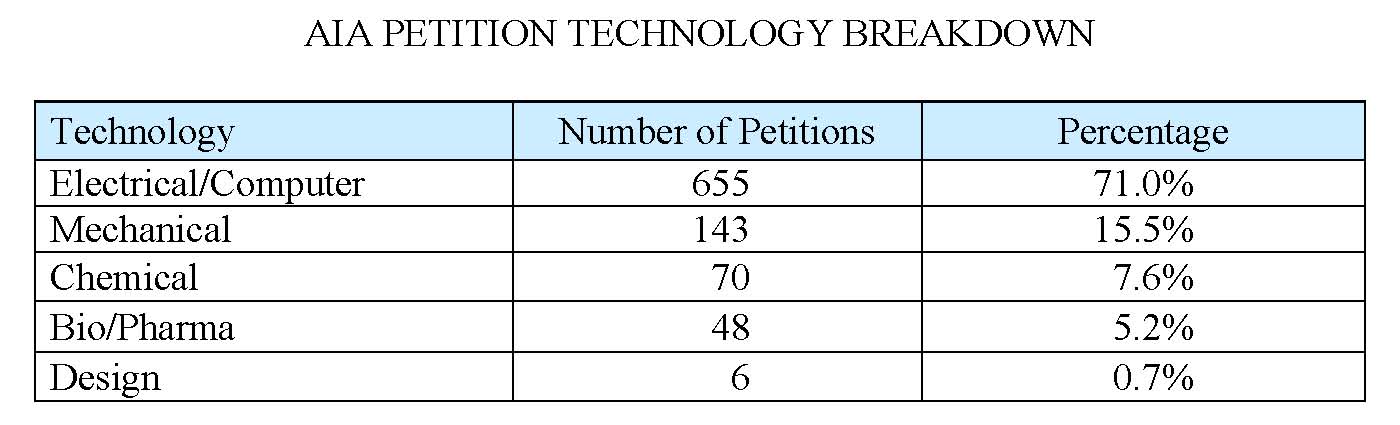
Last week, the USPTO issued the official tallies/progress statistics for Inter Partes Review (IPR), Post Grant Review (PGR) and the Covered Business Method (CBM) proceedings. As of January 9, 2014 the Patent Trial & Appeal Board (PTAB) has received 810 IPR petitions and 108 CBM petitions, 922 petitions in total. Since the last update on November 7, 2013, the PTAB has seen 200 additional petition filings, quite impressive given the holiday season.

(Click to Enlarge)aia_pets_01_09_2014

Not surprisingly, the vast majority of IPR petitions remain in the predictable arts, significant concentrations being in consumer electronics and mobile communication technologies. (a favorite haunt of non-practicing entities (NPEs))

aia_tech_01_09_2014Although difficult to gauge from the numbers due to the lag in filing of preliminary responses across yearly boundaries, it seems that patent owner’s are beginning to appreciate the limited value of preliminary responses.  aia_PR_01_09_2014

aia_inst_01_09_2014

Based upon early numbers, the settlement rate appears to be leveling out at around 15-20%. As more proceedings mature toward written decision the rate may increase. Of course, it is within the discretion of the PTAB to continue to written decision for late stage settlements, especially those attempted after the patent owner response. (See CBM2012-00007)

Patent Reform Effort Returns to Senate

The Senate Judiciary Committee will be scheduling additional staff hearings in the coming weeks on the potential impact of the proposed Patent Transparency & Improvement Act. The additional briefings are responsive to concerns of “unintended consequences” expressed during the last hearing, which was held in late December 2013. The additional hearings are expected to explore the concerns of universities, small innovators and new, smaller targets of evolving patent troll tactics.

With the House passing the Goodlatte Bill in short order at the close of 2013, Patent reform remains a hot issue. It is expected that Congress will continue to move forward at an accelerated pace so that some type of “reforms” can be in enacted into law in the first half of 2014. Given the fast track, it seems unlikely that major changes will be made to the Bill at this point in the legislative process.

AIA patent prosecution

PTAB Review Proceedings Force Change to Age Old Patent Prosecution Paradigm

As Bob Dylan once warned, you better start swimmin’ or you’ll sink like a stone….the times they are a changin.‘ While Bob clearly had some broader ranging social issues on his mind when he penned those lyrics, they are quite befitting of the outdated philosophies driving most U.S patent prosecution practices in the aftermath of the America Invents Act (AIA).

I’m not talking about the change over in March 2013 from the first-to-invent system to the first-inventor-to-file system of the AIA, but instead, the de facto switch in September 2012 from the “infringement first” philosophy of patent prosecution to the new, balanced patentability/infringement model. That is, before the introduction of the AIA post grant challenge mechanisms, Inter Partes Review (IPR), Post Grant Review (PGR), and the transitional program for Covered Business Method Patents (CBM), securing a maximum claim breadth was the primary driver of patent prosecution practices — the broader the better.

The infringement first philosophy is now dead— as will be your patent portfolio unless you change your tune.

Continue Reading Post Grant Proofing Your Patent Portfolio

Virginia Joins Vermont, Nebraska and Others

Yesterday, the Virginia House of Delegates introduced House Bill No. 375, entitled Bad Faith Assertions of Patent Infringement. The bill tracks, in part, similar consumer protection bills introduced in Nebraska and Vermont. Nebraska has taken the matter a step forward and is now proposing that bad faith letters constitute deceptive trade practices, subject to criminal penalties.

These statutes can complicate matters for the handful of trolls that rely on letter writing campaigns for quick, $10,000 settlements (often mailing hotels and restaurants, claiming to own laser printing and/or basic WiFi concepts). These types of trolls are a relatively recent phenomena.

Meanwhile, the Senate is expected to turn to patent reform this month. As a reminder, with the Innovation Act (HR 3309) passed by the House a few weeks back, the Senate is expected to move forward on the companion bill in a matter of weeks.

CAFC

USPTO Appeals to Grow for CAFC

In 2013 the patent-challenging public took notice of the USPTO’s Patent Trial & Appeal Board (PTAB) in a big way. With as many as 100 post-grant patent challenges being pursued per month at the PTAB, the unique considerations required to successfully navigate these proceedings from the PTAB on through to the Federal Circuit will become critical for patentees and third-party challengers alike.

Here is a link to my IP360 article on the topic, entitled 2 Fed. Circ. Rulings Will Impact PTAB Appeals In 2014.