

Manager’s Amendment of H.R. 1249 Passed, Headed to FloorPatent Reform took another step in the direction of passing into law today. In a 32-3 vote, the Manager’s Amendment was passed, along with several small amendments, to the House floor. A full list of all proposed amendments may be found (here). Several deal breaking amendments were proposed, but failed, including a proposal to ditch the first inventor to file scheme, and another to utilize the SNQ standard for Inter Partes Review. Upon passage of H.R. 1249 (and amendments) to the floor, Chairman Smith explained,Today’s vote puts much-needed patent reform one step closer to enactment.  The America Invents Act updates our patent system to make it easier for innovators to produce new technologies that drive economic growth and generate jobs.This important legislation is long overdue.  The last major patent reform was nearly 60 years ago.  Since then, American inventors have helped put a man on the moon, developed cell phones and launched the Internet. But we cannot protect the technologies of today with the tools of the past. Technological innovation from America’s intellectual property is linked to three-quarters of our economic growth.  American IP industries account for over half of all U.S. exports and provide millions of Americans with well-paying jobs. In order to have a healthy economy, we must have a healthy patent system. These reforms discourage frivolous suits, enhance patent quality and streamline international principles. After six years of bipartisan efforts, I look forward to crossing the finish line on patent reform.Expect further political maneuvers on the House floor, still, patent reform is getting very close to becoming reality. 

Patent Reform took another step in the direction of passing into law today. In a 32-3 vote, the Manager’s Amendment was passed, along with several small amendments, to the House floor. A full list of all proposed amendments may be found (here). 

Several deal breaking amendments were proposed, but failed, including a proposal to ditch the first inventor to file scheme, and another to utilize the SNQ standard for Inter Partes Review. Upon passage of H.R. 1249 (and amendments) to the floor, Chairman Smith explained,

Today’s vote puts much-needed patent reform one step closer to enactment.  The America Invents Act updates our patent system to make it easier for innovators to produce new technologies that drive economic growth and generate jobs.

This important legislation is long overdue.  The last major patent reform was nearly 60 years ago.  Since then, American inventors have helped put a man on the moon, developed cell phones and launched the Internet. But we cannot protect the technologies of today with the tools of the past. 

Technological innovation from America’s intellectual property is linked to three-quarters of our economic growth.  American IP industries account for over half of all U.S. exports and provide millions of Americans with well-paying jobs. 

In order to have a healthy economy, we must have a healthy patent system. These reforms discourage frivolous suits, enhance patent quality and streamline international principles. After six years of bipartisan efforts, I look forward to crossing the finish line on patent reform.

Expect further political maneuvers on the House floor, still, patent reform is getting very close to becoming reality.
 

Change on the Horizon for 2011

With 2010 coming to a close, we can look back and see many positive changes at the USPTO. Ex parte and inter partes appeal brief processing has been streamlined, new user friendly BPAI appeal rules are proposed, new pilot programs are being introduced, and the pendency of reexamination proceedings is slowly improving. (I will post a podcast next week going through the full 2010 retrospective, so cancel those holiday plans!)

Looking forward to 2011 there is still significant uncertainty as to the status of patent reform, at least the kind expected from Congress. Will this be the year that something….anything…..comes out of Congress? Patent Reform is still on the minds of Congress, perhaps more so than in past years as it has the potential to be sold as a no-cost economic stimulus. Yet, courts and the USPTO continue to drive the real change in U.S. patent law, especially as it relates to post grant practice before the USPTO.

So, what can we look forward to in 2011?

Aside from the never ending patent reform drama, the CAFC is slated to decide three important patent reissue cases this year, In re Tanaka, In re Staats, and In re Mostafazadeh. Further, CAFC guidance on the inequitable conduct standard is imminent in Therasense, Inc. v. Becton Dickinson and Co. Meanwhile, the Supreme Court is considering perhaps the most important patent litigation case since Festo in i4i Limited Partnership and Infrastructures for Information Inc v. Microsoft Corp.

Finally, and perhaps of most interest to me, the USPTO is working on a new rules package to overhaul aspects of patent reexamination and patent reissue practice.

With patent reexamination filings increasing significantly year over year, and court’s looking to the USPTO for guidance on concurrently litigated patents, it is important that the USPTO focus on keeping the patent reexamination machine humming. To this end, the Central Reexamination Unit has grown in the number of examiners over the past few months, and USPTO management is focused on improving patent reexamination responsiveness. Likewise, patent reissue has been largely ignored over the years, as a result, responsiveness to such filings by the Office has been inconsistent sluggish.

Although, there has been no official announcement, a patent reissue/reexamination rules package should be expected in the coming months designed to improve the responsiveness and quality of these important proceedings. Details on the proposed changes are scant at this point, but it appears at least that patent reissue processing will shifted in some manner to a special group of examiners, perhaps even the Central Reexamination Unit itself. I will keep my fingers crossed; that kind of change is long overdue.

With respect to post grant proceedings at the USPTO, 2011 is shaping up to be a year of change…..I am looking forward to it.

New Ex Parte Patent Reexamination Pilot Program a Tough Sell

Back in August, I reported on a new USPTO pilot program designed to decrease pendency in ex parte patent reexamination by seeking waiver of the right to file a Patent Owner Statement.

According to 2009 PTO statistics, Patent Owners filed statements in 10% of ex parte reexaminations. This is because filing of such a statement gives a Third Party a one-time rebuttal opportunity. Otherwise, Third Party participation is precluded by statute in ex parte reexamination. Therefore, by simply waiting for the Office to issue the first action, the Third Party is effectively silenced for the duration of the proceeding.

The new pilot program seeks to avoid the period of time the USPTO must wait to receive a Patent Owner Statement by requesting an early waiver of this right from the Patent Owner. Assuming the Patent Owner cooperates upon receiving notice of the initial request filing, the USPTO can reduce pendency by avoiding this front loaded, down time.

Since the program has been in operation for a few weeks now, it seemed like a good time to review the early results, and caution certain Patent Owners on how this seemingly trivial question of procedure may come back to haunt them. 

Based upon the preliminary data shown in PAIR, for those requests filed since August 5th, Patent Owners are currently deciding against waiver by about a 3-1 margin. (click to enlarge)

pilot

Of course, the data set is rather small at this point. Nevertheless, not surprisingly, the preliminary data indicates that few Patent Owner’s given the chance, will opt for a more streamlined proceeding.

This chart does not account for 6 cases in which the USPTO was unable to contact the Patent Holder. (As I pointed out in my earlier post, it is not uncommon for reexamination counsel to be different from the counsel listed on the face of a patent).

It is still too early to track the correlation between the refusal to waive the right to file, and ACTUAL statement filings. However, based on my experience, I would guess that most of those refusing to waive their right have no intention on exercising it. Only one case of the 15 declining waiver was a patent owner requested reexamination, thus, I would be surprised if more than one statement was ultimately filed of these 15 cases. Yet, for those Patent Holders conducting a concurrent litigation, refusing to accept the waiver followed by an non-filing may have collateral consequences.

It is just a matter of time before a refusal to accept the USPTOs waiver offer, followed up by the failure to file a statement is used against a Patent Holder in a motion to stay a parallel litigation. Third Parties seeking to stay the case would argue that the Patent Owner was asked by the USPTO to cooperate for the purposes of accelerating the proceeding by several months—but expressly declined, deliberately seeking delay as evidenced by the failure to ultimately file a statement. The argument would continue that this is evidence of the strength of the rejections (fear on the part of the Patent Owner) and, that such gamesmanship and circumstantial evidence of the likelihood of success, weigh in favor of staying the case.

While Patent Owner’s always had a right to waive the statement by simply filing a paper notifying the office (MPEP 2249), clearly this option was rarely exercised by evidence of the new telephone election procedure. Likewise, the interview summary in the record memorializing a lack of cooperation by the Patent Owner may be a bit more damaging in front of a judge….I guess we’ll find out soon enough.

I’ll follow up on the correlation between non-waiver and actual filing in a month or two.

Did the Patent Holder Miss the Boat on Claim Interpretation?On Tuesday, the BPAI seemingly ended the 10 year saga of Ex Parte Gary E. Rhine affirming the examiner’s rejection of expired U.S. Patent 4,910,652.[1] The reexamination was  initiated in April 2000 on behalf of Casio Computer by the now long defunct law firm of Pennie & Edmonds. At issue in the appeal was the patentability of a combination wristwatch/flashlight. In 2002, the Patent Owner amended claim 1 to require a fixed time delay, arguing that the prior art demonstrated an adjustable time delay. However, the reexamination lagged on for years, and prior to appeal, in 2007, the patent expired. On appeal, the USPTO explained that the amendment was effectively withdrawn upon patent expiration in 2007.In a scathing supplemental brief (here) the Patent Owner pointed out that the reexamination had been pending some 10 years, including some unexplained year long gaps in prosecution, bounced appeal briefs, etc. The Patent Owner argued that in light of this delay, it was “outrageous” that the USPTO would withdraw the amendment.While a 10 year pendency is extreme to say the least, this reexamination was filed in a time before the creation of the Central Reexamination Unit (CRU). This case is one of the few remaining with the general examining corps. Likewise, ex parte reexamination appeal rules have been changed to avoid the rejection of appeal briefs late in the game. While not much comfort to Mr. Rhine, fortunately, the patent reexamination landscape has changed significantly over the years.Nevertheless, of perhaps greater interest is why the Patent Owner would amend the claims in the first place since the winning argument was right under his nose.At issue in the appeal was a single independent claim, claim 1 below (as amended): 1. (As Amended) A time keeping and displaying wrist mountable watch having a flashlight mounted in the case thereof, said flashlight comprising:a power supply for supplying electrical power to said flashlight, said power supply electrically connected to at least one light source, andtime delay means for automatically extinguishing said light source after a fixed time delay following the energization of said light source by the electrical deenergization of said light source.  The Office identified the time delay means as being satisfied by the Mallory reference (Fig. 1 below)PPG Comment: Rather than arguing that the “time delay means” of the claim was required to be interpreted under 35 USC § 112 6th paragraph (i.e., means plus function) and that the circuit structure of the specification was nowhere near an equivalent structure to the mechanical spring/bellows arrangement of Mallory, the Patent Holder instead argued the reference was non-analogous art, and could not be bodily incorporated into a watch. Giving the Patent Holder the benefit of the doubt, perhaps the aversion to 112 6th was litigation inspired. For example, the solenoid/capacitive based circuitry of the patent specification, although described as exemplary, could limit infringement options.While the BPAI cannot be blamed for not making the Patent Holder’ s argument for him, I am left wondering whether a statutorily mandated claim construction can be ignored regardless of the implied “waiver” of such arguments in the brief? As pointed out repeatedly on this blog, the USPTO could save Patent Holders a lot of grief, and conserve Office resources by requiring third party requesters to properly address means-plus-function claims, upfront, in their requests for reexamination.[1] Patent Owner sued Casio Computer in 1998 on this patent Rhine v. Casio Inc., Inc., No. 3:96CV7524 (N.D. Ohio May 12, 1998). After a remand from the CAFC, the case was dismissed in 2005 without prejudice in light of the reexaminati

On Tuesday, the BPAI seemingly ended the 10 year saga of Ex Parte Gary E. Rhine affirming the examiner’s rejection of expired U.S. Patent 4,910,652.[1] The reexamination was  initiated in April 2000 on behalf of Casio Computer by the now long defunct law firm of Pennie & Edmonds. At issue in the appeal was the patentability of a combination wristwatch/flashlight. In 2002, the Patent Owner amended claim 1 to require a fixed time delay, arguing that the prior art demonstrated an adjustable time delay. However, the reexamination lagged on for years, and prior to appeal, in 2007, the patent expired. On appeal, the USPTO explained that the amendment was effectively withdrawn upon patent expiration in 2007.

In a scathing supplemental brief (here) the Patent Owner pointed out that the reexamination had been pending some 10 years, including some unexplained year long gaps in prosecution, bounced appeal briefs, etc. The Patent Owner argued that in light of this delay, it was “outrageous” that the USPTO would withdraw the amendment.

While a 10 year pendency is extreme to say the least, this reexamination was filed in a time before the creation of the Central Reexamination Unit (CRU). This case is one of the few remaining with the general examining corps. Likewise, ex parte reexamination appeal rules have been changed to avoid the rejection of appeal briefs late in the game. While not much comfort to Mr. Rhine, fortunately, the patent reexamination landscape has changed significantly over the years.

Nevertheless, of perhaps greater interest is why the Patent Owner would amend the claims in the first place since the winning argument was right under his nose.

At issue in the appeal was a single independent claim, claim 1 below (as amended): 

1. (As Amended) A time keeping and displaying wrist mountable watch having a flashlight mounted in the case thereof, said flashlight comprising:

a power supply for supplying electrical power to said flashlight, said power supply electrically connected to at least one light source, and

time delay means for automatically extinguishing said light source after a fixed time delay following the energization of said light source by the electrical deenergization of said light source.  

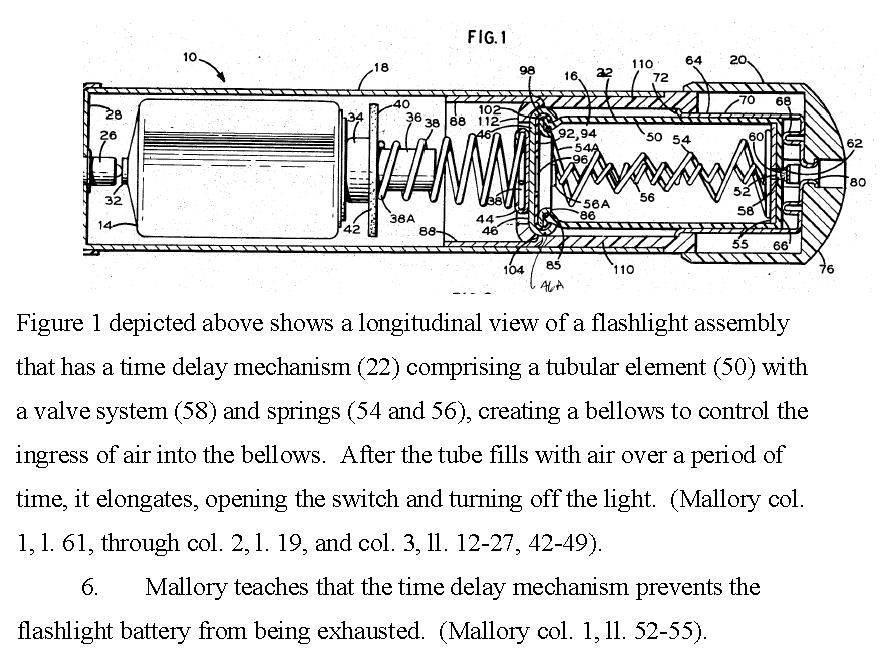
The Office identified the time delay means as being satisfied by the Mallory reference (Fig. 1 below)

Fig1

PPG Comment: Rather than arguing that the “time delay means” of the claim was required to be interpreted under 35 USC § 112 6th paragraph (i.e., means plus function) and that the circuit structure of the specification was nowhere near an equivalent structure to the mechanical spring/bellows arrangement of Mallory, the Patent Holder instead argued the reference was non-analogous art, and could not be bodily incorporated into a watch. Giving the Patent Holder the benefit of the doubt, perhaps the aversion to 112 6th was litigation inspired. For example, the solenoid/capacitive based circuitry of the patent specification, although described as exemplary, could limit infringement options.

While the BPAI cannot be blamed for not making the Patent Holder’ s argument for him, I am left wondering whether a statutorily mandated claim construction can be ignored regardless of the implied “waiver” of such arguments in the brief? As pointed out repeatedly on this blog, the USPTO could save Patent Holders a lot of grief, and conserve Office resources by requiring third party requesters to properly address means-plus-function claims, upfront, in their requests for reexamination.


[1] Patent Owner sued Casio Computer in 1998 on this patent Rhine v. Casio Inc., Inc., No. 3:96CV7524 (N.D. Ohio May 12, 1998). After a remand from the CAFC, the case was dismissed in 2005 without prejudice in light of the reexamination.

ar123551342397313When evaluating a request to stay litigation pending reexamination, district courts generally consider three factors: (1) whether a stay would unduly prejudice or present a clear tactical disadvantage to the non-moving party; (2) whether a stay will simplify the issues in the litigation and facilitate the trial of that case; and (3) whether discovery is complete and a trial date is set.

In an recent opinion, U.S. Magistrate Judge Janie S. Mayeron denied defendants’ motion to stay litigation pending ex parte reexamination because, among other reasons, the reexamination proceedings could not streamline the case. J. Blazek SKLO Podebrady s.r.o. v. Burton Int’l Enterprises, Case no. 08-cv-2354 (D. Minn. June 11, 2010).  At first blush, Judge Mayeron’s rationale for denying the stay seemed illogical as it is certainly the case that, cancellation or amendment of the claims in the patents under reexamination could moot issues of validity, enforceability, infringement, and even damages.

Upon closer inspection, however, this case presents an unusual set of facts in that the Continue Reading Stay Pending Reexamination Denied Because Defendant Did Not Raise Invalidity Defense

–Concurrent Litigation a Driving Force– The USPTO has released their year end statistics for ex parte and inter partes patent reexamination.  The ex parte statistics may be found here, the inter partes hereEx parte numbers are down slightly, it is not clear whether this modest decrease is a function of the overall 2009 economy, or a shift toward inter partes proceedings.  Perhaps tellingly, the inter partes numbers continue to increase at a strong pace year over year.  The statistics indicate that a whopping 68% of inter partes reexaminations are known to be in litigation (32% for ex parte). With the continued influx of inter partes reexaminations to the Office, one has to wonder how the USPTO will keep up with the demand.  Indeed, the Office is increasingly criticized with respect to the growing delays associated with inter partes reexamination.   Tomorrow we will explore how the behavior of inter partes requestors virtually ensures PTO inefficiency, and how such behavior may be discouraged to streamline the proceeding….stay tuned.

In an earlier post, we inquired whether patent claims at the PTO are treated like a “nose of wax.”  Generally, a claim examined by the PTO is given its broadest reasonable interpretation in light of and consistent with the specification of the application or patent in which it appears.  One notable exception to the general rule arises in interferences where an applicant “copies” the claim of a targeted patent or application to provoke the interference.  In this case, if a party challenges the patentability of the “copied” claim pursuant to 35 U.S.C. §112, first paragraph, the “copied” claim is interpreted in light of the specification of the targeted patent or applicationSee Agilent v. Affymetrix, 567 F.3d 1366, 91 USPQ2d 1161 (Fed. Cir. 2009).   A request for an en banc rehearing of the Agilent panel decision was denied by the Federal Circuit.  In Koninklijke Philips Electronics N.V. (“Philips”) v. Cardiac Science Operating Company (“Cardiac Science”) (Fed. Cir. case No. 2009-1241), a second panel of the Federal Circuit has maintained that, when a party challenges the patentability of a “copied” claim Continue Reading “Nose of Wax” Revisited and Should 35 USC § 145 be Revised to Apply to Reexaminations?

This is part two of a three part a series of guest postings by Robert J. Spar, former Director of the Office of Patent Legal Administration.  Bob will be one of featured faculty at PLI’s “Reissue and Reexamination Strategies and Tactics with Concurrent Litigation 2010” conference to be held in San Francisco, CA on January 11-12, 2010; New York, NY, on February 11-12, 2010 and Chicago, IL on March 11-12, 2010. Current Cooperative Arrangement of CRU and OPLA. As previously noted, the CRU is now responsible for the determinations on, and the examinations of, all newly filed requests for XP and IP reexamination proceedings, including monitoring to ensure all actions are timely made, as well as the centralized processing of all reexamination related files and correspondence.  While OPLA was thus relieved of its responsibilities for processing reexamination papers, and for monitoring all the reexamination proceedings that were in the TCs, OPLA’s supporting role was not reduced.  Rather, it actually has increased in both volume, diversity and complexity. Today, OPLA legal advisors handle most of the complex petitions that are filed, and such petitions are not only increasing in number, they are increasing in complexity as one or both of the parties to reexamination proceedings, especially in IP reexamination, are relying on the petitions process to a greater and greater extent to try to game the reexamination process to their advantage.  For example, the unofficial number of petitions handled by OPLA has increased from 280+ in FY 2006, to 300+ in FY 2007, to 465+ in FY 2008, and finally to 570+ in 2009.  This is a very large number of petitions and they cannot be just handled in a pro forma manner.  OPLA now has to rely on 8 to 10 legal advisors to work on reexamination petitions in order to try to handle all petitions within a 2 month guideline, and in a consistent, thorough manner.  Further, efforts are being made in OPLA to handle some petitions, if at all possible, so as to not interfere with, or to minimally interfere with, the reexamination examination process. OPLA continues to train CRU examiners, including both new and existing examiners, and to provide advice and assistance on a regular basis to not only the examiners in the CRU (which have now increased to 55), but also to the SPE’s in the CRU, those examiners handling the remaining reexamination proceedings in the TCs (about 100), as well as to answer questions and queries from an increasingly interested patent bar. As the numbers of XP and IP reexamination proceedings has dramatically increased in recent years, the demands for assistance and advice have correspondingly increased.  For example, XP Requests have jumped from about 270/yr during the 3 year period from FY 2000 to FY 2002, to about 650 yr in FY 2009.  IP Requests have jumped even more dramatically, going from 126 in FY ’07, to 168 in FY ’08, to 258 in FY’09.  Thus, the workload has been significantly increasing, and is expected to continue to increase.  Further, the increasing complexity of such reexamination proceedings, especially the IP reexaminations, has made the examination task much more difficult. OPLA is located immediately adjacent to the CRU on the 7th floor of the Madison West office building in the USPTO complex in Alexandria, Virginia, and this arrangement has proven to be very fortuitous and beneficial.  Not only are the many OPLA legal advisors close by whenever CRU assistance is needed, but also to jointly work out the many process improvements and initiatives to streamline the process which have been implemented in the past few years.