
BPAI Agrees Invalidated Claims are Invalid

In a strange development, the BPAI issued a decision yesterday invalidating claims 1-6 of U.S. Patent 6, 961,737. While the decision itself is straight forward, it is odd in that claims 1, 3, 4 and 6 were previously invalidated by the CAFC.

As discussed this time last year, the ‘737 Patent was one of the patents at issue in In Dow Jones & Co., Inc. v. Ablaise Ltd., (Fed. Cir. 2010). On May 28, 2010, the CAFC determined that all but claims 2 and 5 of the ‘737 Patent were invalid based upon prior art, including a patent identified as the “Bobo Patent.” The decision was noteworthy as footnote 3 explained the final rejection status of the reexamination, lamenting that the appeal may have been mooted altogether had the reexamination been at a more advanced point. At that time I pointed out that had the defendants not delayed their request for some two years that they may have been able to save themselves the cost of the CAFC appeal.

Yesterday, the BPAI essentially agreed with the CAFC, invalidating all claims based on the Bobo Patent, but such was a waste of time and resources. (decision here)

As noted in MPEP 2286, a final Federal Court holding of invalidity or unenforceability (after all appeals), is binding on the Office. Upon the issuance of a final holding of invalidity or unenforceability, the claims being examined which are held invalid or unenforceable will be withdrawn from consideration in the reexamination.

So why did the BPAI waste the time in issuing this appeal decision?

Reading the BPAI appeal, it becomes immediately apparent that the two claims left intact by the CAFC (claims 2 and 5) were not at all the focus of the appeal (See page 7 of the Decision). Instead, the entirety of the appeal discussion was directed to claims previously invalidated by the CAFC. Had the BPAI been aware of the previous decision, it seems their work would have been greatly reduced. (based upon the seemingly conclusory arguments submitted for claims 2 and 5).

PAIR records indicate that briefing was completed prior to the CAFC decision, and the Examiner Answer may have issued prior to the CAFC decision becoming final (expiration of rehearing/appeal time). However, thereafter the dispute continued on to the docketing and ultimate BPAI decision, some 12 months later.

Of course, the Office performs their own litigation searching.  But in cases such as this, where the patent is asserted against a wide swath of industry, digesting all of the various filings can be a formidable task. For this reason MPEP 2282 encourages not only the Patent Owner and Third Party, but any parties to update the Office as to such decisions.

In this case the Decision was provided to the Office by the Patent Owner on June 3, 2010. Unfortunately it was not submitted as a Notice of Concurrent Proceeding (MPEP 2282), but instead, on a Form 1449 IDS filing; for this reason, it was likely overlooked in the file.

Public Notice Function of Interview Summary Attacked by Nokia

In ex parte patent reexamination, the Patentee may “interview” the examiners in charge of the reexamination in an effort to advance the prosecution of the case.  In most cases, the interview is scheduled to last one hour, during which time the Patent Holder may present amendments, explain their invention, attempt to distinguish their claims over the art of record, etc.  At the close of the interview both the examiners and Patentee prepare and file a summary of the discussion for the public record. As discussed previously, the failure to provide an interview summary can have serious consequences for Patentees.

Of course, an interview summary is not a transcript as is the norm for oral hearings in litigation settings. Instead, it is a high level overview of the discussion between the Patentee and the examiners. Yet, as long as the summary is accurate and competently prepared by both sides, the public is well served by this practice.

Still, as many patent reexaminations are now conducted in parallel to litigation, not surprisingly, the lack of an interview transcript is often played up in court by third parties. It is not uncommon for patent reexamination counsel to be subpoenaed and questioned on the interview discussion, motions filed to require the interview be recorded, or even a rare subpoena issued to a USPTO examiner. 

Most recently, in Apple’s battle with Nokia, the adequacy of the USPTO interview record was called into question.  At issue in the dispute with Nokia are Apple Patents 5,315,703 and 5,455,854. Anonymous request were filed against both patents in April of 2010 (presumably by Nokia).  By April 2011 both patents exited reexamination with all claims confirmed. Of course, the USPTO explained exactly why the patents were confirmed, and exactly how the prior art is deficient. Nevertheless, a strange and seemingly wasteful battle over interview summary practice rages on.

Apple motioned to quash the subpeona of their reexamination counsel, explaining (motion here):

. . .Examiners must ensure that the patent owner’s statements of substance of the interview are accurate, M.P.E.P. § 713.04, and the Examiners have not objected to or corrected the content of Apple’s statements of substance of the interviews in any of the reexaminations. In addition to the interview summary, the file wrappers in the Reexamination also contain the detailed slide presentations. . .that were used during the interviews. And most significantly, each interview was followed by Apple’s written Responses to the Office actions, and it was these submissions to the Office that constitute Apple’s official, formal response to the rejections raised by the Office in these reexaminations. 37 C.F.R. § 1.560(b) (“An interview does not remove the necessity for response to Office actions as specified in § 1.111.”).

Nokia responded (motion here):

The details of the events of the interviews are discoverable from the people who attended the interviews. The witnesses cite the reexamination interview summaries as potential alternative sources of information, yet the summaries, as the name implies, are merely summaries. They do not include everything that was said or what transpired at the interviews. For example, the entire interview summary for US Patent 5,315,703 is shown below.

“Patent Owner’s representative provided an overview of the invention and discussed differences between the Cohen reference and the instant invention. Particularly, Patent Owner’s representative argued Cohen failed to teach a notification receiver object (e.g. “receiving the notification by the at least one of the plurality of objects”) and a connection object. Examiner agreed to consider Cohen in light of Patent Owner’s arguments.”

Such a terse and overly simplified summary is hardly sufficient to explain what the witnesses said to the Patent Examiner and how the witnesses specifically characterized the scope of the patent in order to overcome the prior art. Certainly, Nokia is entitled to ask the Witnesses to provide Nokia with the same “overview” of the invention and the differences between the Cohen reference and the invention. The only mechanism to ensure that Nokia can obtain the best description of what was said is to depose all the individuals present. (emphasis added)

Although Nokia did not mention any attempt to subpeona the examiners present, such is especially difficult. (assuming the examiners would even remember anything from 50 or so  interviews ago) MPEP 1701.01 is instructive in this regard:

A request by a third party to take deposition testimony of a patent examiner in a pending ex parte reexamination proceeding will generally be denied in view of the ex parte nature of the reexamination proceeding. . .

If an employee is authorized to testify, the employee will be limited to testifying about facts within the employee’s personal knowledge. . . . ShafferTool Works v. Joy Mfg. Co., 167 USPQ 170 (S.D. Tex. 1970) (deposition of examiner should be limited to matters of fact and must not go into hypothetical or speculative areas or the bases, reasons, mental processes, analyses, or conclusions of the examiner in acting upon a patent application).  . .

In view of the discussion above, if an employee is authorized to testify in connection with the employee’s involvement or assistance in a quasi-judicial proceeding which took place before the USPTO, the employee will not be permitted to give testimony in response to questions that the Office determines are impermissible. Impermissible questions include, but are not limited to, questions directed to discovering the mental processes or expertise of a quasi-judicial official, such as:

. . . .(5) Consultation with another Office employee;

(6) Understanding of:

(a) A patented invention, an invention sought to be patented, or patent application, patent, reexamination or interference file;

(b) Prior art;. . . .

(7) Reliance on particular facts or arguments;

(B) To inquire into the manner in and extent to which the employee considered or studied material in performing a quasi-judicial function; or

(C) To inquire into the bases, reasons, mental processes, analyses, or conclusions of that Office employee in performing the quasi-judicial function.

The prosecution history in these cases, like most reexamination records, are quite clear and easy to follow as to the reasons for termination. Nokia’s true gripe seems to be that the written record is not as helpful to their case they had hoped, but that does not make it incomplete from a public notice standpoint….it just means the prior art wasn’t as good as originally thought.

Interference Model to Control Petition Explosion & Manage Filings

Last Wednesday, the USPTO conducted a public meeting to receive comments on their proposals to streamline patent reexamination. For those that missed the webcast last week, the PTO will be posting the presentations of the various speakers in the near future.

To recap, the meeting was organized into three parts. In the opening session, several speakers explained their belief that the “representative rejection” proposal was inconsistent with aspects of the MPEP. Additional speakers noted that the Office’s reliance upon In re Freeman (CAFC 1994) to support proposals requiring amendments in patent reexamination to be related to patentability (under35 USC § 305)  was misplaced. (arguing that the the oft cited language of Freeman was merely dicta). In the second portion of the program, Judge Robinson of the Federal District of Delaware, and Judge Essex of the ITC provided their perspectives on patent reexamination. In the final portion of the program, petition practice was discussed.

My slides on creating an inter partes patent reexamination pilot program for procedural petitions are found (here). The slides explain that

the reexamination petition crisis at the USPTO is a direct result of the increased use of inter partes patent reexamination. With many such petitions having to do with page limits, improper filings and the like, the Office would be best served disposing of these petitions by involving an ombudsman that is available by telephone, akin to interference paralegals. A later phase of the pilot program would further integrate inter partes patent reexamination as a BPAI proceeding (as may soon be required by the patent reform legislation) by allowing substantive, interview-like hearings.

With regard to the complaints of late mail/service in inter partes patent reexamination, I proposed that this problem would be avoided by requiring web portal filing as is the case in patent interference. As patent interferences have become less common as of late, and may be legislated away in the coming months, it would seem that the Office may have some bandwidth freeing up.

Later this week I will discuss my proposal relating to the Pilot Program for Waiving the Patent Owner Statement. This aspect of the USPTO proposals was not discussed in detail during the meeting.

Obama Administration Backs Patent Reform Bills  

In letters Tuesday to the Chair (Lamar Smith R-TX) and Ranking Member (John Conyers D-MI )of the House Judiciary Committee, Secretary of Commerce Gary Locke lauded the patent reform efforts as currently detailed in S.23 an H.R. 1249. As previously explained, it is expected that Patent Reform will be high on the June 2011 House agenda.  In an attempt to grease the skids a bit, Secretary Locke emphasized the Administration’s economic stimulus rationale, stating:

The Administration continues to strongly support the bipartisan efforts of Congress to enact patent reform legislation that will accelerate innovation, and create new jobs, new industries and new economic opportunities for Americans. Enactment of a balanced bill is an important part of the Administration’s goal of “out-innovating” our economic competitors and winning the future –and it can be done with no cost to taxpayers and no addition to the deficit. (emphasis added)

A copy of the letter can be found (here). With respect to the proposed changes to patent reexamination and the new post grant review mechanism, Secretary Locke explained:

The Administration supports establishing a new post-grant review proceeding and retooling the existing post-grant inter partes reexamination procedure. These proceedings will serve to minimize costs and increase certainty by offering efficient and timely alternatives to litigation as a means of reviewing questions of patent validity. Such proceedings also will provide a check on patent examination, ultimately resulting in higher quality patents. It is important that post-grant review proceedings be designed to prevent delay and abusive challenges, but still enable valid challenges based on meritorious grounds

We believe that the provisions contained in H.R. 1249 -including those covering regulatory authority, threshold and estoppel issues -will adequately address these concerns. Various safeguards and flexibilities are included in the proposed proceedings to enable USPTO to effectively implement and manage them. The bill also establishes a time-limited transitional post-grant review proceeding, which would enable the USPTO, upon petition, to review the validity of a limited range of business method patents to address particular challenges faced in this technology area as a result of case law developments.

The House is expected to pick up H.R.1249 mid-month. The Judiciary reported the bill out yesterday (report here, bill here) With the support of the Obama administration, and the previously expressed support of Republican House leadership, the Patent Reform legislation seems on the fast track to passage before the end of summer.

Webcast Today at 1:30PM (EST)

As discussed back in April, the USPTO has proposed a collection of working concepts and initiatives in the Federal Register for the purpose of streamlining patent reexamination. Based upon public commentary, the USPTO will consider implementing/modifying the various proposals via a formal rule-making process, or through internal policy changes. (a copy of the Federal Register Notice is found here)

The proposals are directed to both ex parte and inter partes patent reexamination (see above link for more detail).

Today, the USPTO will conduct a public meeting to receive comments on their streamlining proposals.  For those that did not pre-register, or are unable to attend in person, you may tune into the webcast at 1:30PM here.

The meeting is scheduled for 1:30PM-5PM, today’s agenda may be found (here)

I will post any available meeting materials later today.

2011 Patent Reexamination Appeal Results (Q1-Q3)

As discussed last week, every quarter, the BPAI releases general statsistics on patent reexamination appeals.  As promised, I have now gathered statistics that are specific to the type of reexamination proceeding. (Special thanks to the USPTO for providing me these figures).

Below are statistics from October 1, 2010 through May 20, 2011.  Note that Q3 of FY 2011 has not yet closed, so, these statistics to not quite cover all of Q1-Q3.  First let’s look at the overall statistics for 2011.

overall

(Click to enlarge)

As explained last week, the three year results for patent reexamination appeals indicate that the examiners of the Central Reexamination Unit are affirmed, at least partially, in roughly 70% of cases.  

Preliminary results for FY 2011, as shown in the chart above by the number of filings and percentage x,y%, indicate that the affirmance rate is trending  upward with roughly 80% of cases including some form of affirmance (61 % Affirmed, 19% Affirmed-in-part). Reversal rates are coming in at about 17%, which is slightly lower than 2009 and 2010 (see 2009 and 2010 stats here).

Below is the break out of these statistics into ex parte and inter partes patent reexamination categories.

Not surprisingly, as ex parte patent reexamination proceedings make up the bulk of the sample, these case closely track the general patent reexamination statistics.

ex parte

(Click to enlarge)

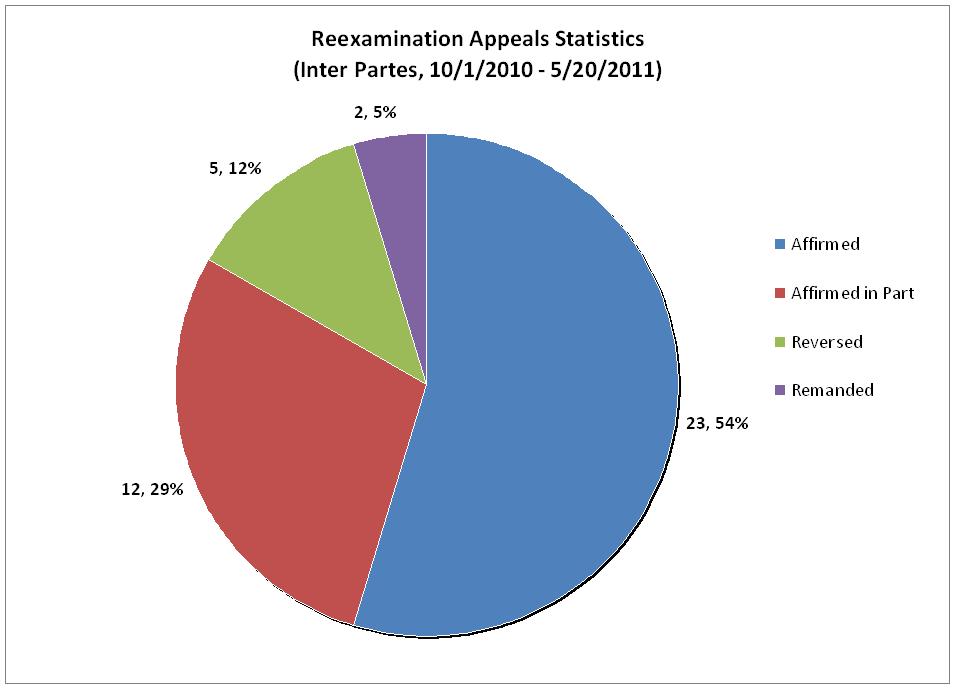
BPAI results in inter partes patent reexamination exhibit only slightly more variability. Affirmance rates in these proceedings is roughly 83% (affirmed 54%, in part 29%). 

ipr

(Click to enlarge)

As mentioned previously, an affirmance in inter partes patent reexamination is not always a victory for challengers as allowed claims are also subject to appeal in such proceedings.

While the ex parte patent reexamination statistics for FY 2011 are based upon a sample size that is double that of inter partes, it may be that the variation between the proceedings is just a statistical anomaly. Yet, one would expect examiner rejection to fare better on appeal when supported by the efforts of an additional party. The difference between absolute affirmance rates in inter partes and ex parte patent reexamination appears to be accounted for by a corresponding increase in the affirmance-in part rate of the inter partes proceedings. This may be a reflection of the cross appeal mechanism that is unique to this proceeding.

It is hoped the BPAI will publish future statistics to account for the type of reexamination proceeding.

Recent Changes to Patent Reissue Practice

As discussed here at length, there have been two recent decisions of the CAFC that will impact patent reissue practice before the USPTO, In re Tanaka and In re Mostafazadeh. In Tanaka, the CAFC held that the addition of narrower, dependent claims in patent reissue is an “error” contemplated by the patent reissue statute. In Mostafazadeh, the CAFC, while siding with the USPTO on the facts, corrected the USPTO’s position on the recapture rule.  The CAFC explained that a claim may be broadened with respect to previously surrendered subject matter (i.e., recapture) if the claim is also materially narrowed with respect to the surrendered subject matter. (previous post here).

Another important question relating to patent reissue practice remains pending at t he CAFC(In re Staats)

On June 2, 2011, my partner Steve Kunin will speak on these issues and more in a Webinar entitled “Recent Federal Circuit Decisions on Reissue”  To register for this 1 hour program click here.

Important Decision Attempts to Address Plague of Inequitable Conduct Accusations in Patent Litigation

Today the CAFC decided Therasense Inc. v. Becton Dickinson and Co. In this landmark decision, the CAFC reconsidered the doctrine of inequitable conduct, deciding that:

While honesty at the PTO is essential, low standards for intent and materiality have inadvertently led to many unintended consequences, among them, increased adjudication cost and complexity, reduced likelihood of settlement, burdened courts, strained PTO resources, increased PTO backlog, and impaired patent quality. This court now tightens the standards for finding both intent and materiality in order to redirect a doctrine that has been overused to the detriment of the public. (Decision at 24) (full decision here)

As previously discussed, this decision will have an important impact on patent reexamination practice, as well as application prosecution in relation to the duty of disclosure, good faith, and candor. With the tightening of the materiality standard, (described below) monstrous IDS filings may now be a remnant of the past.

Interestingly, the CAFC has now adopted a “but for” standard of materiality, such as employed in a Walker Process claim (antitrust).

The CAFC explains:

This court holds that, as a general matter, the materiality required to establish inequitable conduct is but for materiality. When an applicant fails to disclose prior art to the PTO, that prior art is but-for material if the PTO would not have allowed a claim had it been aware of the undisclosed prior art.  Hence, in assessing the materiality of a withheld reference, the court must determine whether the PTO would have allowed the claim if it had been aware of the undisclosed reference. In making this patentability determination, the court should apply the preponderance of the evidence standard and give claims their broadest reasonable construction. § 706, 2111 (8th ed. Rev. 8, July 2010). Often the patentability of a claim will be congruent with the validity determination—if a claim is properly invalidated in district court based on the deliberately withheld reference, then that reference is necessarily material because a finding of invalidity in a district court requires clear and convincing evidence, a higher evidentiary burden than that used in prosecution at the PTO. However, even if a district court does not invalidate a claim based on a deliberately withheld reference, the reference may be material if it would have blocked patent issuance under the PTO’s different evidentiary standards. See MPEP §§ 706 (preponderance of the evidence), 2111 (broadest reasonable construction). (emphasis added)  (Decision at pages 27-28).

As I pointed out previously, with the USPTO being in the best position to prove materiality, and with a more liberal standard, it may be that this decision creates yet another compelling reason to pursue patent reexamination. For example, it may be that a defendant pleads inequitable conduct and encourages the  courts to stay the case pending the outcome of this crucial “but for” determination.

In any event, the recalibration of inequitable conduct is long, long overdue.

Rare Victory in Patent Reexamination

Since the amendment of claims is not practical in many instances during patent reexamination (due to intervening rights), declaration evidence is much more common in patent reexamination as compared to patent application prosecution. A common form of declaration evidence introduced in patent reexamination, although only rarely successful, attempts to identify objective evidence of non-obviousness. MPEP 716.01(a) lists several categories of evidence that may tend to refute an obviousness determination.

–Evidence of criticality or unexpected results
–Evidence of commercial success
–Long-felt but unsolved needs
–Failure of others
–Skepticism of experts

As discussed in past posts, the submission of objective evidence of non-obviousness is often undermined by a chronic failure to persuasively identify a nexus between this evidence and the patented claims. Occasionally, however, evidence of secondary indicia of non-obviousness can be the difference between winning and losing.

Yesterday, in Ex Parte Textron Innovations the BPAI was persuaded that the certain evidence of secondary considerations was sufficient to rebut the showing of obviousness, while other such evidence was not. Textron’s U.S. Patent 6,047,530 relates to gang-type rotary mowers. Crucial in the showing of secondary considerations pertaining to copying was evidence produced in a previous litigation of the Textron patent against the Toro company. (D.Del 2010).

The Board explained with respect to the secondary indicia relating to copying that:

insert1 .          .          .         .          .          .          .          .insert2

Here, internal documentation of a major competitor provided crucial evidence of copying. Of course, absent the benefit of the previous litigation discovery, such valuable evidence would never have been available to the Patentee. While this case is illustrative of the potential game changing value of such evidence in patent reexamination, it also demonstrative of the practical difficulties of assembling persuasive evidence in this regard.