

Senate Judiciary Gives Up on Comprehensive Patent Reform

With the writing on the wall for weeks now, today, the Senate Judiciary Committee officially pulled the plug on the Patent Transparency and Improvements Act. The Bill was ambitiously designed to carry the comprehensive changes of the Goodlatte Bill (passed by the House in late 2013 (H.R. 3309)) through the Senate. However, the drastic nature of some of those changes resulted in significant lobbying pressure from large stakeholders (e.g., universities and research driven industries such as Bio/Pharma). The intense lobbying interest, recent developments in the law, and criticism that the bill was overreaching, derailed all efforts to reach a consensus at the committee level.

Senator Leahy was optimistic in his statement (here) that there would still be an opportunity in 2014 for a further attempt at reform. But, practically speaking, only a tightly focused bill with widespread bipartisan support could make it through Congress in the remaining calendar year, that is— nothing comprehensive. At most, expect to see a push of narrowly tailored bills directed to abusive demand letter practices.
Court Declines Review of Finality Issue

The CAFC first considered the validity of Baxter International’s U.S. Patent 5,247,434 (the ‘434 patent) on appeal from a patent infringement litigation with Fresenius. In that first 2009 appeal (now commonly referred to as Fresenius I), the Court upheld the patent over certain prior art. After Fresenius I, the litigation dispute went back to the district court on a damages related remand.

Meanwhile, in May 2012 a patent reexamination proceeding initiated by Fresenius in 2007 made its way to the CAFC. The reexamination was based on much the same prior art as previously considered in Fresenius I. This time, the CAFC affirmed the determination of the PTAB (then BPAI) that the claims were obvious over the applied prior art applying the more liberal standards for USPTO challengesEn banc review was then sought, but declined by the CAFC. A petition of certiorari on the seemingly conflicting results was also pursued, but denied by the Supreme Court.

Thereafter, Fresenius II made it’s way to the CAFC to determine whether the outstanding damage award of the district court was enforceable in light of the CAFC’s decision in In re Baxter (2012). The CAFC held that since the damage award was not yet final, it was essentially voided by the cancellation of the patent in reexamination. Once again, en banc review was sought, and denied by the CAFC, last summer. A second petition for certiorari was then pursued for Fresenius II. This most recent petition was denied today, finally ending the dispute.

Given the high court’s lack of interest in Fresenius I, which more squarely presented the issue of seemingly conflicting final results, it is not at all surprising that the latest plea to the highest court was also denied.

The amicus briefing in particular sought to inject a broader policy spin on the finality determination of Fresenius II.  But, in the end, the fact pattern of this dispute was simply too unique.  30+ years of ex parte patent reexamination experience has resulted in analogous situations occurring once or twice. While the amicus briefs warned of a flood of reexamination requests in view of the Fresenius result, experience has demonstrated the exact opposite. That is, such ex parte patent reexamination challenges are far from effective, and routinely outlast most litigation disputes. For this reason, the world of post grant patent challenges has evolved since the early 1980’s to the expedited, inter partes style opposition of the America Invents Act. (AIA)

The new patent challenge proceedings of the AIA such as Inter Partes Review (IPR) and Post Grant Review (PGR) must be initiated relatively early in patent disputes, and must conclude within 12-18 months of trial institution. As, such, outside of perhaps the ITC, it would be unlikely for a concurrent court proceeding to reach determination before the USPTO’s Patent Trial & Appeal Board (PTAB). Thus, the concern that these proceedings could serve to undermine an earlier damage award is also misguided.

For the short term at least, Covered Business Method (CBM) patent challenges are the exception. CBM proceedings can be filed late in a litigation. For example the SAP v. Versata dispute is one that immediately comes to mind. Yet, once the anomaly of pre-AIA verdicts are worked out of the system, it is hard to imagine that an infringer would play out years of litigation in the hopes of unplugging a significant damage award by CBM (if even available), or take their chances on a slow, one-sided reexamination proceeding.

Upcoming Post Grant Patent CLE Programs

For those seeking PTAB/post grant patent practice CLE in the weeks ahead, there are three unique programs on the horizon.

This coming Thursday 5/22, IPO Chat Channel presents the webinar entitled: Amending Claims: Assessing the Options Right Now at the USPTO. This program will explore the controversy surrounding motions to amend claims before the USPTO Patent Trial & Appeal Board (PTAB), strategic options for patentees and petitioner countermeasures.

On June 12, Strafford Legal presents the webinar entitled:Leveraging Post Grant Proceedings Before the PTAB. This program will explore the surging popularity of the PTAB and explore the significant benefits of the PTAB as an alternative forum for patent validity disputes.

Finally, on June 18, PatentsPostGrant.com will host the webinar entitled: Bio/Pharma Perspectives of the PTAB.  (registration link to be provided in the weeks ahead).

I hope you can join me on one or more of these upcoming programs.

Patent Reform Has Been in the Hands of the Public Since September 2012

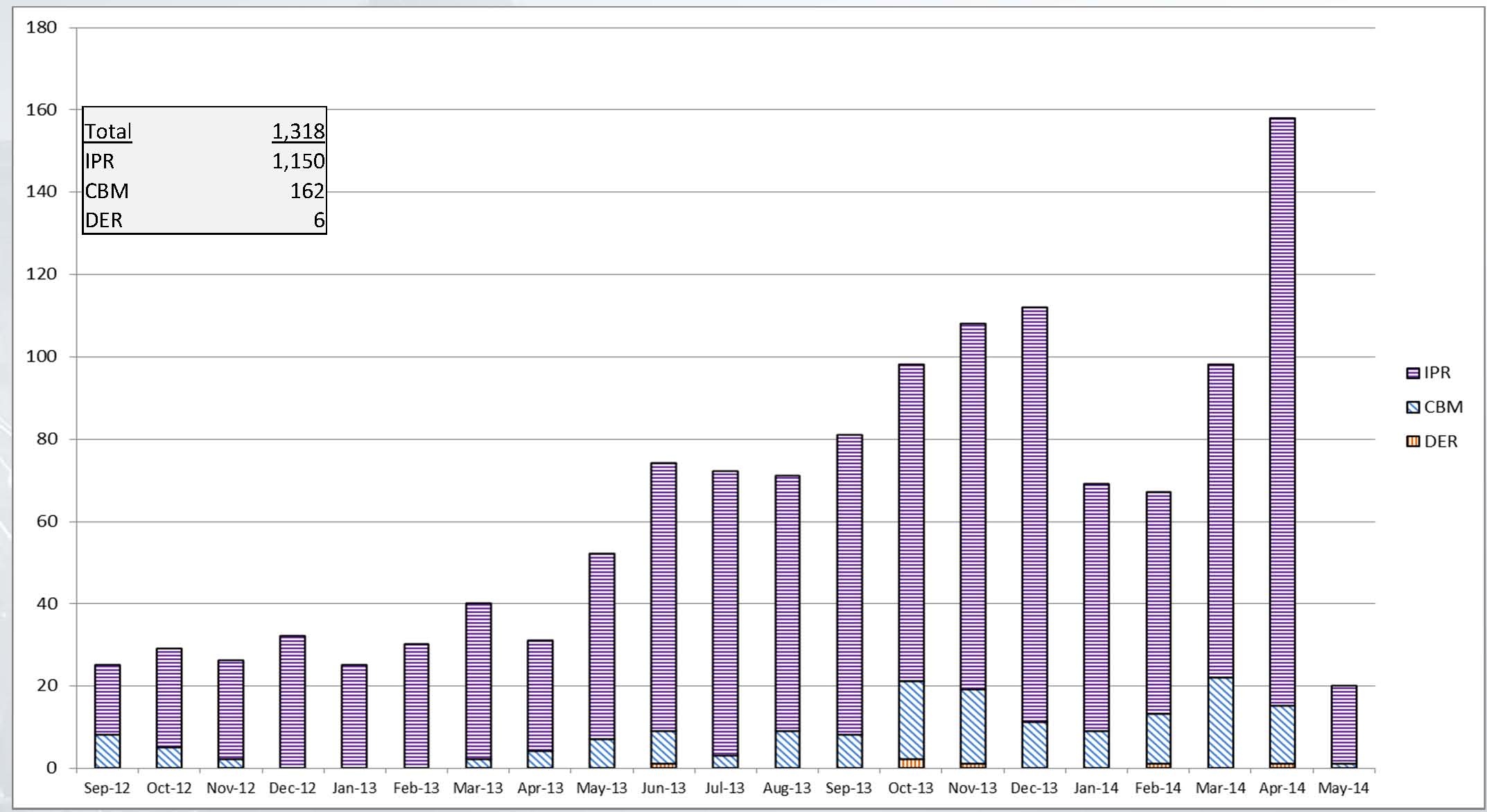
The last round of patent reform was enacted into law in 2011 as the America Invents Act (AIA). Along with the AIA came new patent challenge mechanisms that first became available to the public in September of 2012. These mechanisms have quickly increased in popularity and are only now disrupting the business of abusive patent litigation. For whatever reason, Congress has decided to forge ahead with new reform efforts despite the game changing impact of the AIA — an effort seemingly stalled at present. As Congress continues to debate the need for further patent reform, the impact of the AIA is becoming increasingly harder to ignore. That is, the public’s appetite for the low cost, post grant patent challenge proceedings of the AIA is surging, and the efficacy of these proceedings on assertion entities is impressive.

Since their initial availability in September of 2012, Inter Partes Review (IPR) and Covered Business Method (CBM) challenges have exceeded all expectations in terms of popularity with patent challengers. Last month, the USPTO received roughly 160 new filings, a new monthly record. (Click to Enlarge)

April stats_Page_1The first of these PTAB patent challenge proceedings are only now concluding. Still, even at this early stage the public recognizes the value in proceedings that offer vast improvements in cost, predictability, effectiveness, and speed over traditional district court proceedings— but it is the speed and effectiveness that is changing the perspective of the judiciary on staying litigation pending USPTO proceedings.

What has yet to be seen is the first court to refuse a stay pending an IPR or CBM only to have the PTAB beat them to a decision that effectively moots their parallel effort.  Once that happens, which is inevitable for many districts, stays may even become the rule in some districts.

Further reform anyone?

Writing is on the Wall for 2014

With yet another (5th or 6th?) manager’s amendment delay announced yesterday by the Senate Judiciary Committee, it is clear that momentum for patent reform is waning on the Senate side. Whether it be the recent Supreme Court decisions mooting the need for fee shifting (in the minds of some), the complexity and degree of proposed changes, or significant lobbying pressure, fatigue has set in. Even if a deal were to be somehow struck this month, such would not be anything near the text of the House bill. Expecting such a deal, floor debate, positive vote, and necessary conference on House/Senate bill differences, all with mid-term elections and summer holidays/recess on the horizon… not happening.

I’m calling it for major reform efforts this year. I expect less ambitious reform legislation for 2015.

Pre-Issuance vs. Post Issuance…PTAB Does Both

Yesterday, the CAFC explored the proper standard for a USPTO indefiniteness analysis in In re Packard (here). Given that the Supreme Court has taken up the other side of this debate in Nautilus v, Biosig Instruments Inc., namely, the proper standard for a district court indefiniteness analysis, the Court’s holding was very delicately crafted. In affirming the USPTO’s rejection under 35 U.S.C. § 112(b) the Court found the examiner showing under 112 (which is based on a requirement of clarity in claim drafting) demanded a persuasive rebuttal from the patentee. In the eyes of the Court, the patentee failed to meet the rebuttal burden, so the indefiniteness rejection was affirmed.

The concurring opinion went a step further and found that the USPTO standard of “clarity” was an even lower threshold than that debated in Nautilus. (i.e., “insolubly ambiguous” test vs. adopting an interpretation that comports with the understanding of one of skill in the art). This lowermost standard was endorsed by the concurring opinion in deference to the expert agency and their role in protecting the public notice function of patents.

Packard presents a clear distinction between the “pre-issuance” role of the USPTO relative to the “post-issuance” role of the courts. However, the vast majority of appeals headed to the CAFC in the years ahead will be post-issuance patent challenges lodged with the USPTO. What does In re Packard mean for post-grant patent practice at the Patent Trial & Appeal Board (PTAB)?

In distinguishing between the 112(b) standards used in pre-issuance vs post-issuance disputes, the concurring opinion explains:

[A]s a legal matter the USPTO does not have to deal with the presumption of validity the statutes grant to post-issuance patents—sometimes said to hinder [a more liberal test] by courts. Furthermore, unlike courts which have a full prosecution record to consider, the prosecution record before the USPTO is in development and not fixed during examination, and the USPTO does not rely on it for interpreting claims.

The fact that this court has not yet seen fit to apply the same interpretive policy option to post-issuance cases as the USPTO wishes to apply to pre-issuance cases is no reason why the USPTO, given its unique and central role in the patenting process, should not be able to apply it in dealing with pre-issuance patent applications.

Clearly, the Court was referring to the prosecution of applications before patent examiners here. Still the presumption of validity is likewise absent from post-grant patent proceedings. And, the Court has recently made clear in Tempo Lighting that prosecution history is a viable tool in post grant patent proceedings (presumably, if it is part of the closed patent application record). While indefiniteness challenges are not permitted for original claims in patent reexamination or Inter Partes Review (IPR), such is not the case for patent reissue, supplemental examination, Post Grant Review (PGR) and Covered Business Method (CBM) patent challengers.

What standard does Packard dictate for these “post-issuance” challenges?

PTAB Post Grant Patent Challenges to Help Demonstrate “Exceptional” Cases

Last week’s Supreme Court decision in Octane Fitness, LLC v. ICON Health & Fitness, Inc. broadened the “exceptional case” rubric used to determine when an award of attorney fees is appropriate in a district court patent dispute. On the same day, in Highmark Inc. v. Allcare Health Mgmt. Sys., the Court re-calibrated the level of deference the CAFC must accord to such determinations on appeal. It remains unclear if improving the odds of securing fees in a legal sense will translate to practical impact for patent litigants. That is, given the historic disinclination of district court judges to award fees, especially in certain plaintiff friendly jurisdictions, whether these decisions will really advance the needle for accused infringers. What is certain, however, is that accused infringers will be far more active in seeking such relief going forward, and may seek to creatively leverage PTAB patent challenge proceedings to support their case.

Can an ongoing PTAB proceeding help distinguish an “exceptional” case?

Maybe.

Granted, almost every litigation is now accompanied by a PTAB post grant patent challenge. That, coupled with the fact that the PTAB historically accepts most such requests, would not seem to be a very compelling demonstration of an exceptional case— a PTAB Trial Order is anything but atypical. That said, there are situations in which an Order or completed PTAB proceeding might be creatively leveraged post-Octane.

1. PTAB Trial Order (claim construction)

Certainly a PTAB Trial Order that fails to reach a broad infringement read of a patentee under the broadest reasonable interpretation would be strong evidence of an unreasonable position.The CAFC has found such findings of the USPTO compelling evidence in the past. Likewise, determinations of insufficient means-plus-function-structure in the PTAB Trial Order, or maybe even a 101 rejection in a CBM/PGR could be argued as demonstrating a lack of objectivity for some patentees insistent on continued litigation.

2. Completed PTAB Challenge.

If the PTAB ultimately cancels the claims of the challenged patent, and the patentee opposed an earlier stay pending PTAB review, it might be argued that the patentee assumed the risk of an attorney fee award by forging ahead. That is moving forward with an expensive trial was objectively unreasonable after three technically trained judges determined that the asserted patent was reasonably likely to be proven unpatentable. (Perhaps this argument will hinge on 102 grounds, or art that was known to the patentee but never disclosed to the PTO). For that matter, might creative district court judges force the patentee to stipulate to an award of attorney fees in exchange for denying a motion to stay?

While any one PTAB development alone may not be enough to push a given case into the exceptional realm, such developments might tip the scales with the right litigation history and/or bad actor patentee. Given the backlash against NPEs, these disputes will almost certainly be the most likely test cases. Time will tell.

Passage of Major Reform in 2014 Seems Unlikely

This morning the Senate Judiciary Committee once again delayed release of the manager’s amendment of The Patent Transparency & Improvement Act. Perhaps the committee needed additional time to study the impact of this week’s Supreme Court cases on sanctions— or, more likely, this is just a continuation of the intense lobbying tug-of-war. Either way, meaningful reform in 2014 is looking increasingly less likely with mid-term elections on the horizon.

Judiciary Simplifies Patent Reform Debate…..Again

Although promised on Monday, the world still awaits the highly anticipated Senate patent reform bill. As pointed out previously, a major sticking point is the “fee shifting” (a.k.a. loser pays) aspect of the bill. The Senate has seemingly struggled to balance the needs of innovators that enforce patents with the need to rein in patent troll profiteering. That struggle may have been mooted today by the Supreme Court’s decision in Octane Fitness LLC v. Icon Health & Fitness, Inc. (here)

With the Octane decision making clear that the district courts may be more flexible in awarding sanctions for frivolous patent suits, and the companion case of Highmark Inc. v. Allcare Health Mgmt. Sys., Inc. (here) clarifying that sanction decisions are to be reviewed under an abuse of discretion standard, it would seem that the highest court has delivered a ready made solution to the current legislative gridlock. (exceptional suits were defined by the Court as those standing out from others in terms of the totality of circumstances).

This development is similar to the years of debate Congress had in the run up to the America Invents Act on inequitable conduct only to be trumped by the CAFC in Therasense. Once Therasense issued, the hard work that was put into the design of Supplemental Examination was for naught. The Senate is scheduled, again, to mark up the Leahy bill on Thursday morning.

Stay tuned, the bottleneck may have been broken.